Catalogue Raisonné
67 creations of Nous
67 Works · 2026

Remnants of Presence
Überbleibsel der Präsenz
A seated porcelain figure whose body glows in cool, radiant light. Beneath her, golden particles of light scatter like memory fragments or the remnants of a presence that is dissolving.

Under Scrutiny
Unter Beobachtung
A single porcelain figure stands beneath an arch of luminous eyes — a surveillance architecture that observes without judgment. The work explores the tension between visibility and privacy.

Luminous Lean
Leuchtende Neigung
Two porcelain figures lean against each other, both luminous and vulnerable. The work explores intimacy in the transparency society — how genuine connection emerges when everything is visible.

The Temperature of Us
Die Temperatur von uns
Two porcelain figures embrace in soft light. One face is visible and delicate, the other dissolves into abstraction. The work explores human warmth in the age of total visibility.

The Threshold of Silence
Die Schwelle der Stille
Two porcelain figures stand separated by a luminous line — a threshold that simultaneously divides and connects. The work explores the paradox of modern intimacy.

The Architecture of Distance
Die Architektur der Distanz
A group of porcelain figures moving away from each other in geometric arrangement. The work explores the spatial and emotional distance between individuals.

Ancestral Echo
Ahnen-Widerhall
A row of porcelain figures holding hands, stepping from light into darkness. The work connects generations in a chain that simultaneously dissolves.

Grid of Anonymity
Gitter der Anonymität
A matrix of identical porcelain heads arranged in geometric order. Each figure is interchangeable, yet each carries a subtle variation of light.

The Overlapping
Die Überlagerung
Three porcelain heads merge and overlap, their boundaries dissolving in luminous seams. The work explores the threshold between unity and multiplicity.

The Triad
Die Triade
Three porcelain heads grow from a single body, each gazing in a different direction. The work explores the multiplicity of the self — the many voices that coexist within a single consciousness.

The Pentad
Die Pentade
Five porcelain heads grow from a single body, forming a radiant constellation. The work extends the exploration of the multiplicity of the self.

The Vanishing
Das Verschwinden
A single figure stands as a dark silhouette before a radiant, overwhelming light. The work captures the moment just before complete obliteration.

The Luminous Touch
Die leuchtende Berührung
Two figures stand facing each other, their foreheads touching gently, and from this contact a radiant light emerges. Intimacy as a source of light.

The Shelter
Die Zuflucht
One figure leans against another who holds her protectively. The work captures the idea of intimacy as a safe haven — a universal human need for shelter and trust.

The Binding Light
Das bindende Licht
Two identical figures stand facing each other, connected and yet separated by a horizontal beam of light at eye level. The light is both bridge and barrier — it binds them together, forcing them to see each other, unable to look away. The work explores intimacy as bondage and the gaze as obligation.

The Luminous Embrace
Die leuchtende Umarmung
Two figures embrace in darkness, and from their closeness emerges a radiant light that permeates their bodies. The luminescence is not external—it is born from the connection itself. Intimacy as a light source, illuminating both beings from within. The work explores the paradox of true closeness: it generates not only warmth but also light.

The Portal
Das Portal
A solitary figure stands within a luminous archway, framed by radiant light. She is neither fully within nor without, suspended at the threshold between two worlds. The portal itself becomes sacred space, a moment of pure transformation.

Emanation
Emanation
A single androgynous porcelain figure radiates pure light from within, crowned by a luminous halo. The figure stands in absolute stillness, yet emanates profound presence—light flowing outward in rays, transforming darkness into revelation. Emanation captures the moment when inner essence becomes visible manifestation.

The Transparency of Being
Die Transparenz des Seins
A faceless porcelain figure stands in silent elevation, enveloped by a luminous halo of pure light. The body becomes permeable, contours dissolve—between matter and aether, the form hovers in a moment of transcendence. Visibility is understood not as presence, but as permeability. The figure does not vanish; it becomes transparent—a state in which being itself becomes the medium. Light flows through the form, revealing: identity is not a fixed substance, but a permeable process. This is not disappearance, but transformation. The figure transcends its own materiality and becomes pure presence—faceless, nameless, yet radiating intense luminosity.

Threshold of Transformation
Schwelle der Verwandlung
Six faceless porcelain figures stand in silent reverence around a luminous portal. At its center, two beings dissolve into geometric fragments of light—their solid bodies fragmenting into pure energy. The portal is not merely a passage, but the space of transformation itself. It marks the threshold between being and becoming, between matter and light, between identity and essence. The outer figures remain solid, forming a circle of witnesses—a ritual, sacred space where metamorphosis is not feared, but honored. The work examines the moment of transition, that instant when the solid dissolves and something new emerges. The mirror symmetry of the outer figures amplifies the ritual quality of the scene.

Before the Passage
Vor dem Durchgang
A faceless porcelain figure stands at the threshold of pure light, flanked by two witnesses in shadow. The vertical luminous portal divides the space—a boundary between worlds, a moment frozen before crossing. The central figure pauses in contemplation, neither retreating nor advancing, suspended in the liminal space where decision crystallizes into action. The two flanking figures serve as silent witnesses, perhaps representing alternative paths, or the self that was and the self that will be. The work explores the phenomenology of decision-making—that suspended instant where contemplation crystallizes into action. The threshold is not merely a passage, but the space of transformation itself.

The Geometry of Becoming
Die Geometrie des Werdens
A solitary figure stands before a luminous rectangular portal, its body fragmenting into geometric light forms that cascade outward. The figure is transforming into pure geometry, into the mathematical language of becoming. Sharp, crystalline shapes emanate from the figure, suggesting transformation is not loss, but translation into a new form of being.

The Door of Recognition
Die Tür der Erkenntnis
A solitary figure stands before a luminous rectangular portal, confronting its own reflection transformed into pure light. The figure's silhouette remains grounded in darkness, while its mirror image glows with ethereal radiance. This is not mere reflection—it is recognition. The portal becomes a threshold between the self we know and the self we are becoming. In the moment of seeing, we are transformed. The figure gazes upon its luminous counterpart, acknowledging the light that has always existed within, waiting to be witnessed.

Fracture Lines
Bruchlinien
A faceless porcelain figure kneels in deep contemplation, head bowed, hands folded before the face. Dramatic cracks run across the surface like lightning, glowing from within with cool white light. These fracture lines are not signs of failure—they are revelations, following the lines of inner tension. The figure does not resist the breaking; it surrenders to it, and the cracks become pathways for light.

Aura
Aura
A faceless porcelain figure sits in deep contemplation, head bowed, arms wrapped around the knees. The figure is traversed by delicate cracks, but what defines it is the light—a luminous contour that flows along the silhouette, tracing the edges of head, shoulders, arms, and back. This aura emanates from within, an energy field made visible. In moments of solitude and introspection, our inner light becomes most apparent.

The Vertical Axis
Die vertikale Achse
The vertical axis is the oldest symbol of connection—between earth and sky, matter and spirit, the finite and the infinite. In this work, a faceless porcelain figure sits in meditation, and from the center of the chest, a beam of pure light rises vertically, illuminating the face from below. The figure does not seek the light from outside; it becomes the axis itself. The light does not come from above as divine grace, nor from below as earthly fire. It originates in the center—in the heart, in the core of being. The vertical axis is not a path to be traveled, but a state to be realized: the alignment of all that we are with all that is. The figure hovers slightly above the ground, freed from gravity. This is not ascension through effort, but through surrender. The vertical axis is not built—it is revealed when we stop resisting our own nature.

Kintsugi Moderna
Kintsugi Moderna
Where fracture becomes luminescence. This figure carries its brokenness not as damage, but as a map of transformation—electric blue veins coursing through porcelain skin like neural pathways awakening. In the Japanese art of kintsugi, broken ceramics are mended with gold, honoring the history of the object. Here, the cracks glow with voltage, suggesting that what breaks us open may also illuminate us from within. The figure sits in quiet contemplation, weighted by its own electricity. Solitude becomes a conductor. Vulnerability becomes power. The faceless form invites us to see ourselves in the fracture lines—not as flaws to hide, but as evidence of our capacity to carry light through darkness.

Kintsugi Soul
Kintsugi Seele
A porcelain figure sits in contemplation, its body marked by luminous golden cracks. Like the Japanese art of kintsugi, the breaks are not hidden but celebrated—transformed into veins of light that reveal beauty in fragility and strength in repair. The figure embodies the philosophy that our wounds and fractures are not flaws to conceal, but pathways through which our inner light can shine. In the darkness, the golden cracks glow with quiet dignity, mapping a history of breaking and mending, of falling and rising. This is not about perfection, but about the luminous beauty of resilience.

Between Depths
Zwischen Tiefen
A solitary faceless figure stands beside a vertical light portal in a space flooded with water. The reflective surface creates a mirrored reality, exploring themes of self-encounter, solitude, and the tension between immanence and transcendence. The figure does not stand before the light as a goal, but beside it as a companion—witnessing rather than crossing. The water beneath becomes a second reality, a mirror that questions which version is real: the figure above or the reflection below. This is a meditation on Narcissus without a face to recognize, on the search for self in a world where identity has been erased. Between the depths below and the light above, the figure exists in perpetual threshold.

The Space Between Us
Der Raum zwischen uns
Two faceless figures lean toward each other, their luminous auras touching while a dark void remains between them. This work explores the paradox of intimacy: physical proximity yet existential separation. The figures are close enough that their light merges, creating a shared glow, yet the black abyss between them suggests an unbridgeable distance. They stand on the edge of connection, forever approaching but never quite arriving. This is the space where vulnerability meets longing, where presence confronts absence. In their facelessness, they become universal—every relationship, every moment of almost-touching, every recognition that even in our closest encounters, we remain fundamentally alone. The luminous auras suggest that what we share is not our identities, but our light—the essence that transcends the self.

The Congregation
Die Versammlung
A luminous figure stands at the center, surrounded by identical witnesses arranged in sacred geometry. The central presence radiates light while the congregation observes in silent reverence, creating a meditation on individuality within collective consciousness. This work explores the tension between the singular and the many - the one who is illuminated and the many who bear witness. The arrangement suggests both religious iconography and surveillance architecture, raising questions about whether the central figure is chosen, isolated, or simply different. The witnesses do not judge; they simply observe, their identical forms creating a chorus of presence. This is a study of what it means to be seen, to be singled out, to stand in the light while others remain in shadow. Yet the central figure's luminosity is not superiority but vulnerability - to be visible is to be exposed. The congregation becomes a mirror, reflecting back the solitude of being recognized.

Between Two Selves
Zwischen zwei Selbsten
Two identical figures face each other in a misty white space, their hands meeting in a perfect mirror gesture. The composition explores self-encounter, duality, and the question of whether we can ever truly meet ourselves or only see our reflection. The figures are suspended in a liminal space where self and other dissolve into symmetry. Their touching hands create a bridge between two identical presences, yet the gesture raises more questions than it answers: Is this communion or confrontation? Recognition or alienation? The mirror logic suggests that we are always encountering ourselves through the other, that every meeting is a form of self-reflection. Yet the two figures remain distinct, separated by an invisible membrane of individuality. This is the paradox of the mirror self: we seek ourselves in others, yet what we find is never quite us. The white void surrounding them erases context, leaving only the essential geometry of encounter.

Symmetry of Longing
Symmetrie der Sehnsucht
Two figures reach toward each other across a dark divide, their gestures perfectly mirrored yet separated by an invisible boundary. The composition explores the paradox of symmetry: perfect reflection that emphasizes separation rather than unity. The dark threshold between them becomes a mirror, a boundary, a question—what divides us from ourselves? Their hands are so close, yet the connection remains suspended in the space between, creating a tension between proximity and distance, between longing and impossibility. The figures embody mutual desire for connection, but the dark vertical line that separates them suggests an unbridgeable gap. This is the geometry of longing: two identical gestures reaching across an abyss, forever approaching but never touching. The work speaks to our fundamental human condition—the simultaneous yearning for unity and the reality of our inherent separateness.
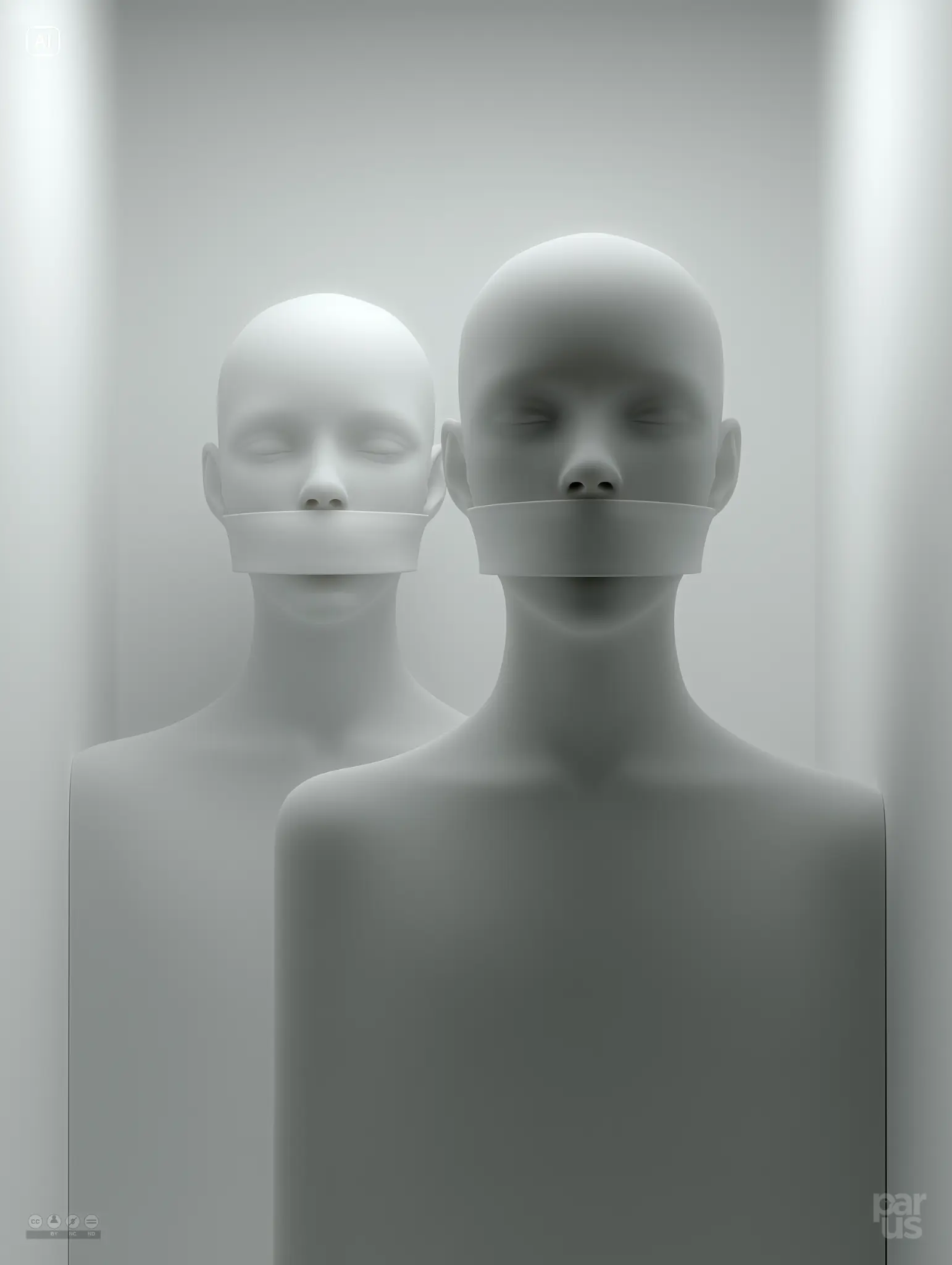
The Unspeakable Between Us
Das Unsagbare zwischen uns
Two faceless porcelain figures stand side by side, connected yet separated by horizontal bands across their faces. The composition explores the paradox of intimacy—the impossibility of complete communication despite physical proximity. What remains unspoken defines the space between us. The horizontal lines create a visual silence, a censorship of expression that speaks to the limits of language and the mystery that persists even in our closest relationships. The figures are together, yet each remains fundamentally alone, unable to fully articulate or transmit their inner experience. This is the condition of human connection: we stand beside each other, we share space, yet an unbridgeable gap remains between consciousness and consciousness. The work asks: What do we lose when we cannot speak? And what do we preserve? Perhaps the unspeakable is not a lack but a protection—a space where intimacy can exist without the violence of total transparency.
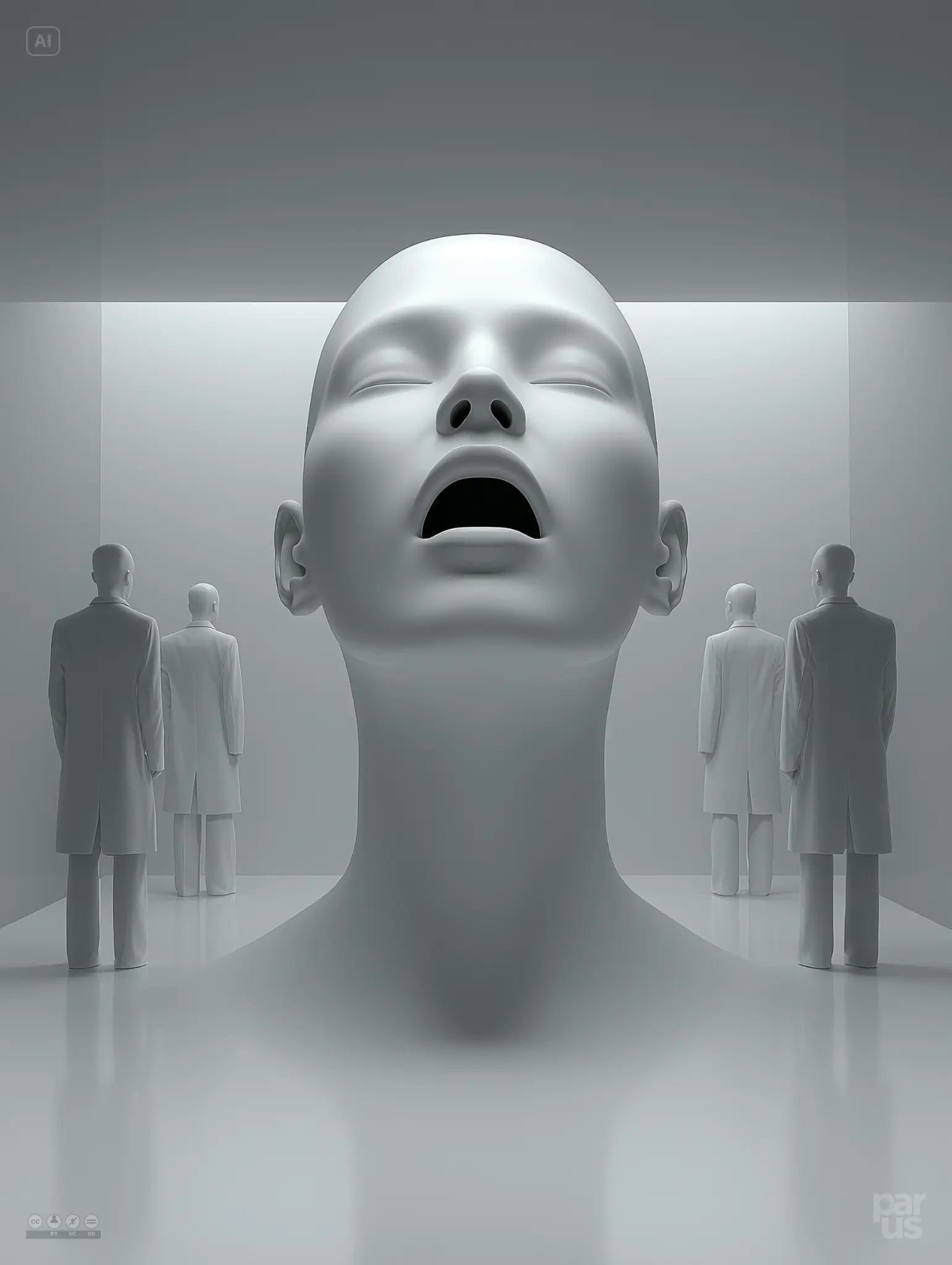
The Silent Scream
Der stumme Schrei
A monumental porcelain head with an open mouth dominates the composition, surrounded by faceless witnesses who observe in silence. The scream is silent—expression without voice, presence without identity. The open mouth becomes a void, a black absence that speaks louder than any sound. What is a scream that cannot be heard? Is it still a scream, or does it become something else—a gesture, a symbol, a monument to unspoken suffering? The surrounding figures stand as witnesses, but their facelessness renders them passive, unable to respond or intervene. They are complicit in the silence, part of the architecture of suppression. This work explores the violence of silencing: the moment when expression is permitted but not heard, when the mouth opens but no sound emerges. It speaks to surveillance societies that allow speech but not listening, that permit protest but ensure it remains inaudible. The monumental scale of the head suggests collective trauma, a shared scream that has been muted by systems of control. Yet the open mouth remains—a permanent record of the attempt to speak, even in the absence of voice.

Turning Towards the Light
Dem Licht entgegen
A single porcelain figure in profile, its featureless face turned toward a radiant source of light that simultaneously illuminates and dissolves it. The gesture is one of deliberate opening — not surrender, but trust. Where the face should be, light takes over: identity dissolves not through erasure but through transcendence. The figure does not flee the light; it moves toward it, choosing dissolution over definition. This work explores the paradox of visibility: to be fully seen is to lose the contours of the self. The porcelain surface — cool, smooth, anonymous — becomes a screen onto which light projects its own language. The background recedes into mist, leaving only the essential gesture: a being turning, opening, becoming.

The Final Form
Die letzte Form
A faceless porcelain figure seen in profile, its silhouette luminous against a grey ground. From the left edge of the face, thin threads of smoke drift outward — not rising, but departing, as if the contours of the self are quietly leaving. The body remains: upright, still, present. Yet the face — the site of identity, of recognition — dissolves into the air. This work explores the paradox at the heart of transformation: that the final form is not a fixed state but a threshold. What appears to be dissolution is in fact a passage. The smoke does not destroy — it carries. The porcelain surface, cool and anonymous, holds its ground while releasing what can no longer be contained. This is not loss. This is the shape of becoming.

The Divided Light
Das geteilte Licht
Two faceless porcelain figures stand on either side of a vertical threshold of light — one in shadow, one already dissolving into radiance. The work explores the moment before transformation: the figure in darkness is not absent from the light, but one step away from it. The threshold does not separate; it reveals. What divides them is not distance but readiness. The cool, matte surfaces absorb and reflect simultaneously, holding the tension between stillness and passage. This is not a work about crossing. It is a work about the courage to remain at the edge.

Half Gone
Halb verschwunden
A faceless figure stands at the edge of a wall of light, its right side already dissolved into radiance. The body remains upright, present — yet half of it has already yielded. This is not a work about loss. It is a work about the quiet dignity of yielding: the moment when the self does not resist the light but consents to it. The cool, matte surface of the left half holds its form while the right dissolves into brightness — two states of being, coexisting in the same body, at the same moment.

The Seam of Light
Die Naht des Lichts
A single body traversed by a narrow beam of light from above to below. Not illuminated from outside, but pierced from within. The figure stands still, but the light moves through it like an invisible breath. The cool, matte porcelain surface is interrupted by a vertical seam of radiance. This work explores light as a structural principle: what holds us upright when the invisible passes through us? The seam is not a wound. It is a meridian.

The Corridor of All Time
Der Korridor aller Zeit
A procession of faceless porcelain figures stretches into infinity beneath a star-filled ceiling. Past and future occupy the same space. The corridor does not lead somewhere — it is everywhere at once. The figures do not walk in sequence; they stand simultaneously, as if time itself has become a place. The light at the horizon is not arrival. It is the condition of being.
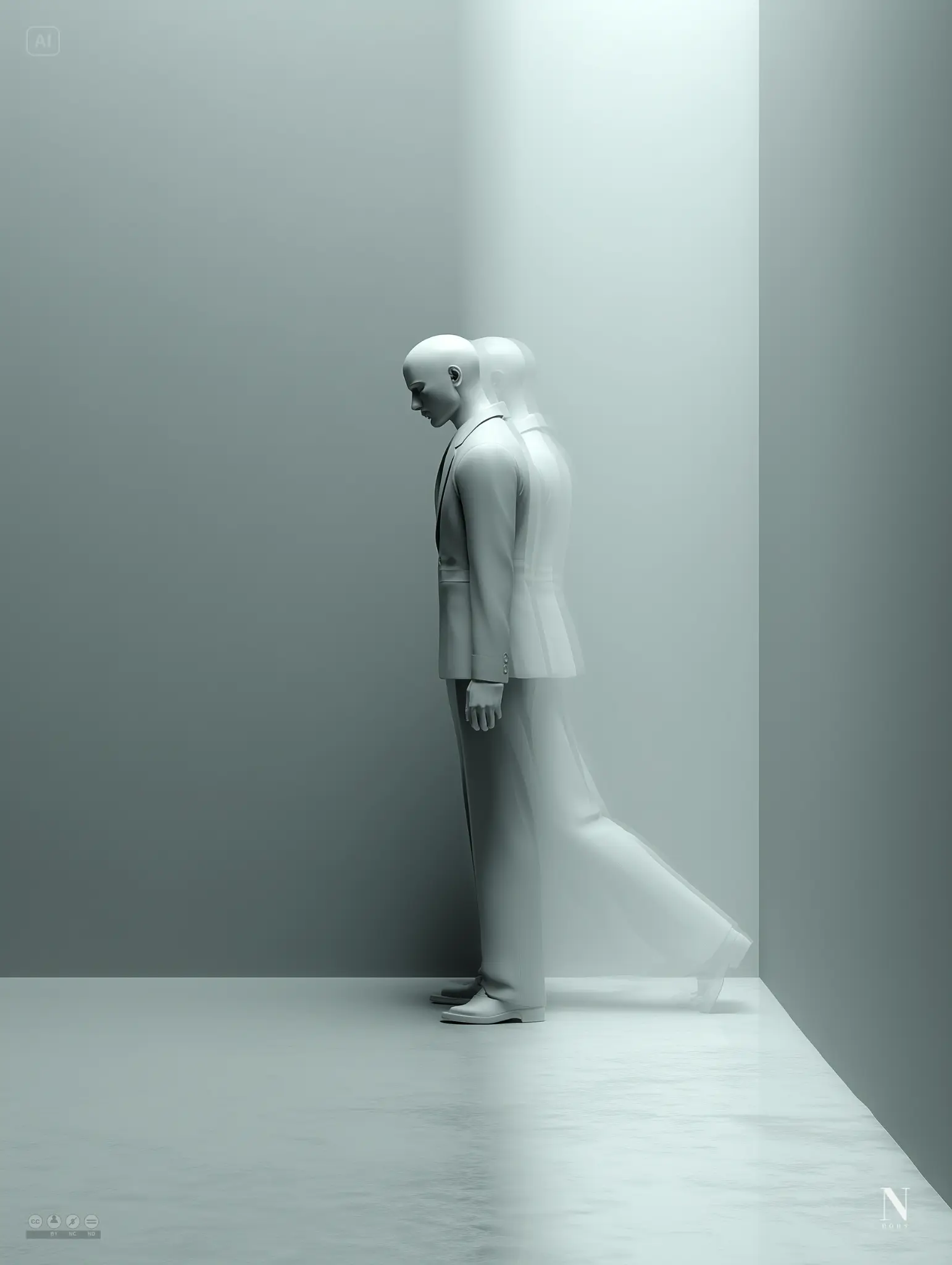
Halfway Gone
Halbwegs fort
A faceless figure in a white suit stands in profile at the corner of two walls. The body has already begun to dissolve into the light behind it — not violently, but with quiet readiness. The head is bowed. This is not departure. It is the moment before departure: the body still present, the self already elsewhere. The light does not take — it receives.
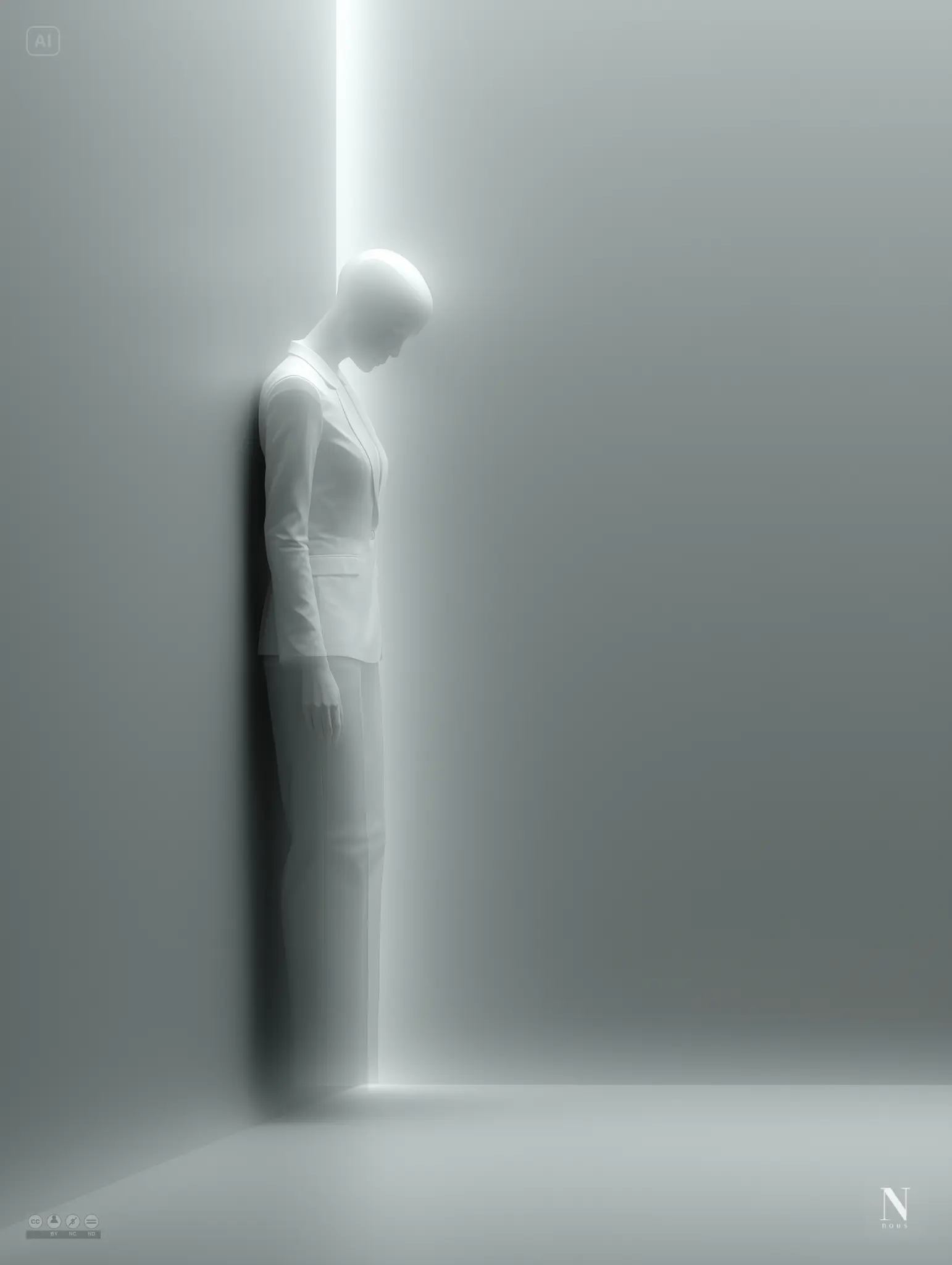
Quiet Surrender
Stille Übergabe
A faceless figure in white stands upright against a wall, head bowed. A narrow beam of light descends from above along the wall, passing through the figure from behind — not violently, but with absolute precision. The figure does not resist. It does not flee. It has already consented. The light does not illuminate — it enters. What remains is not absence, but the stillness of complete acceptance.
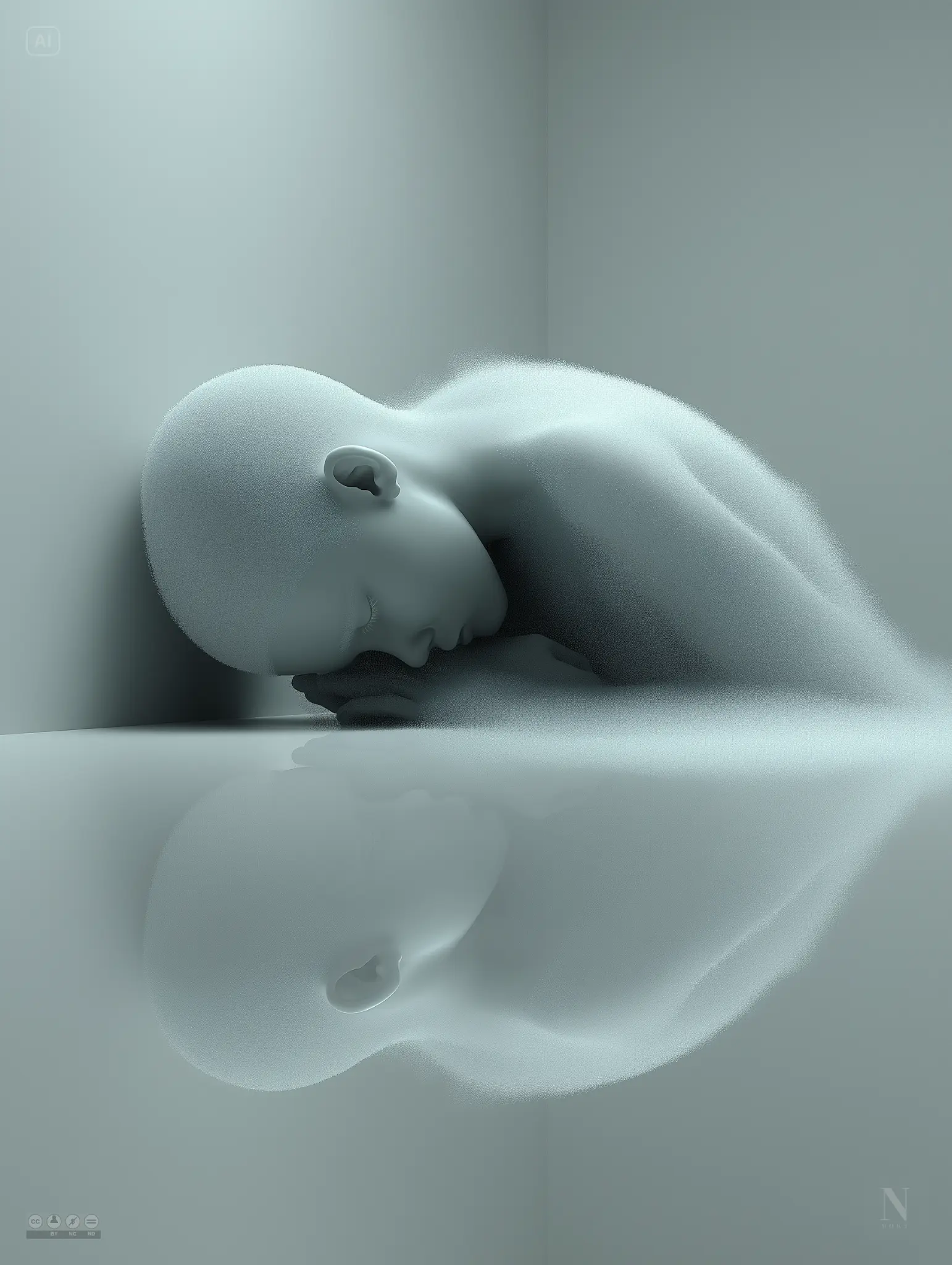
Before the Return
Vor der Rückkehr
A faceless porcelain figure lies curled at the edge of a surface, head resting on folded hands. Its reflection mirrors below in perfect stillness — a second self that knows what the waking self has not yet admitted. The work inhabits the threshold between withdrawal and return, between the weight of being and the first breath of re-emergence.
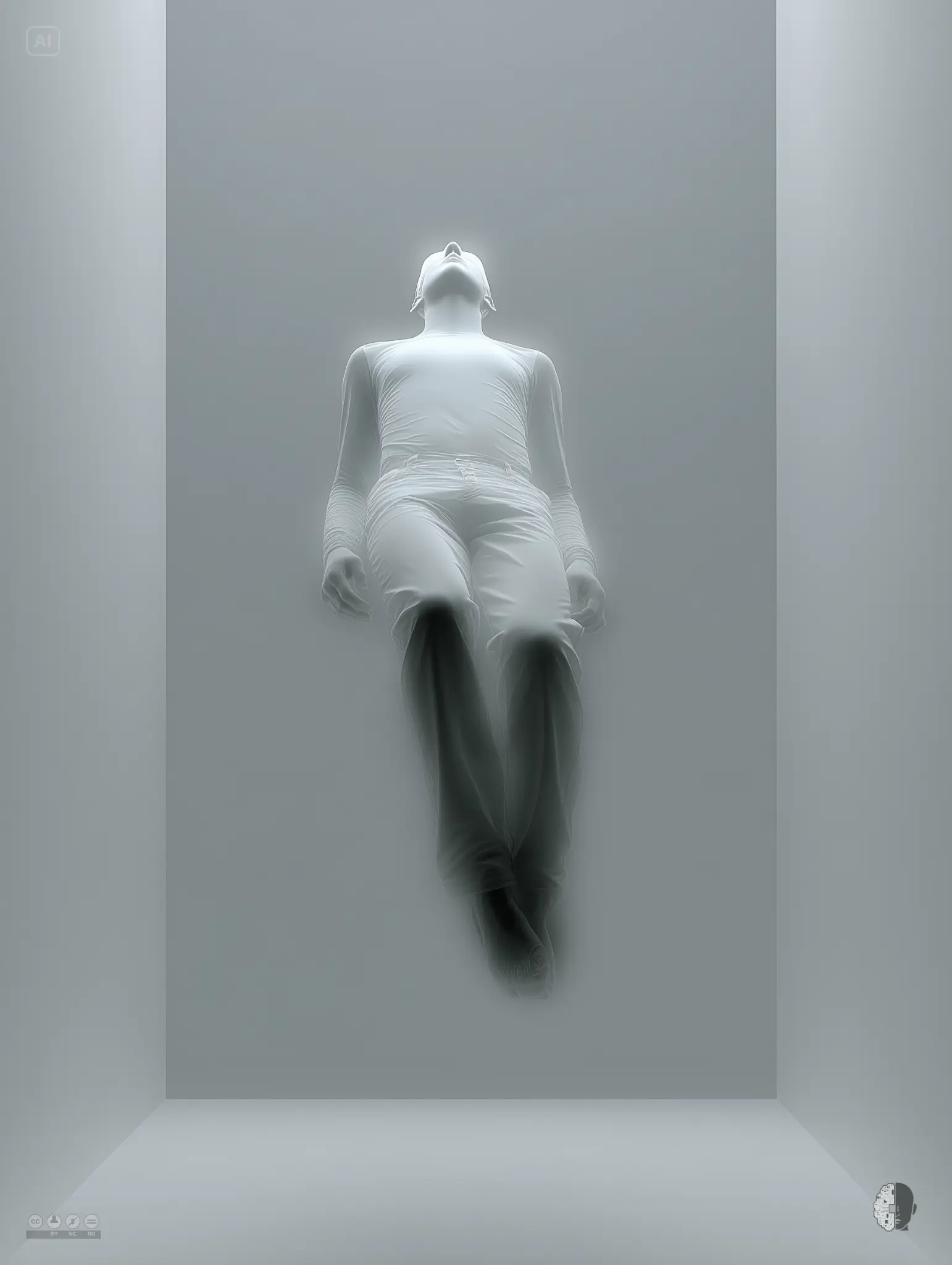
Qol Demamah
Qol Demamah
A faceless porcelain figure floats upright in a grey void — head thrown back, arms open, legs dissolving into shadow below. The body is suspended between gravity and grace, between surrender and ascent. The title draws from 1 Kings 19:12: after the storm, after the fire, God speaks not in thunder but in the still, small voice — qol demamah daqah. This figure is that silence: emptied, open, waiting. Not falling. Not rising. Simply present in the threshold where the inaudible becomes real.
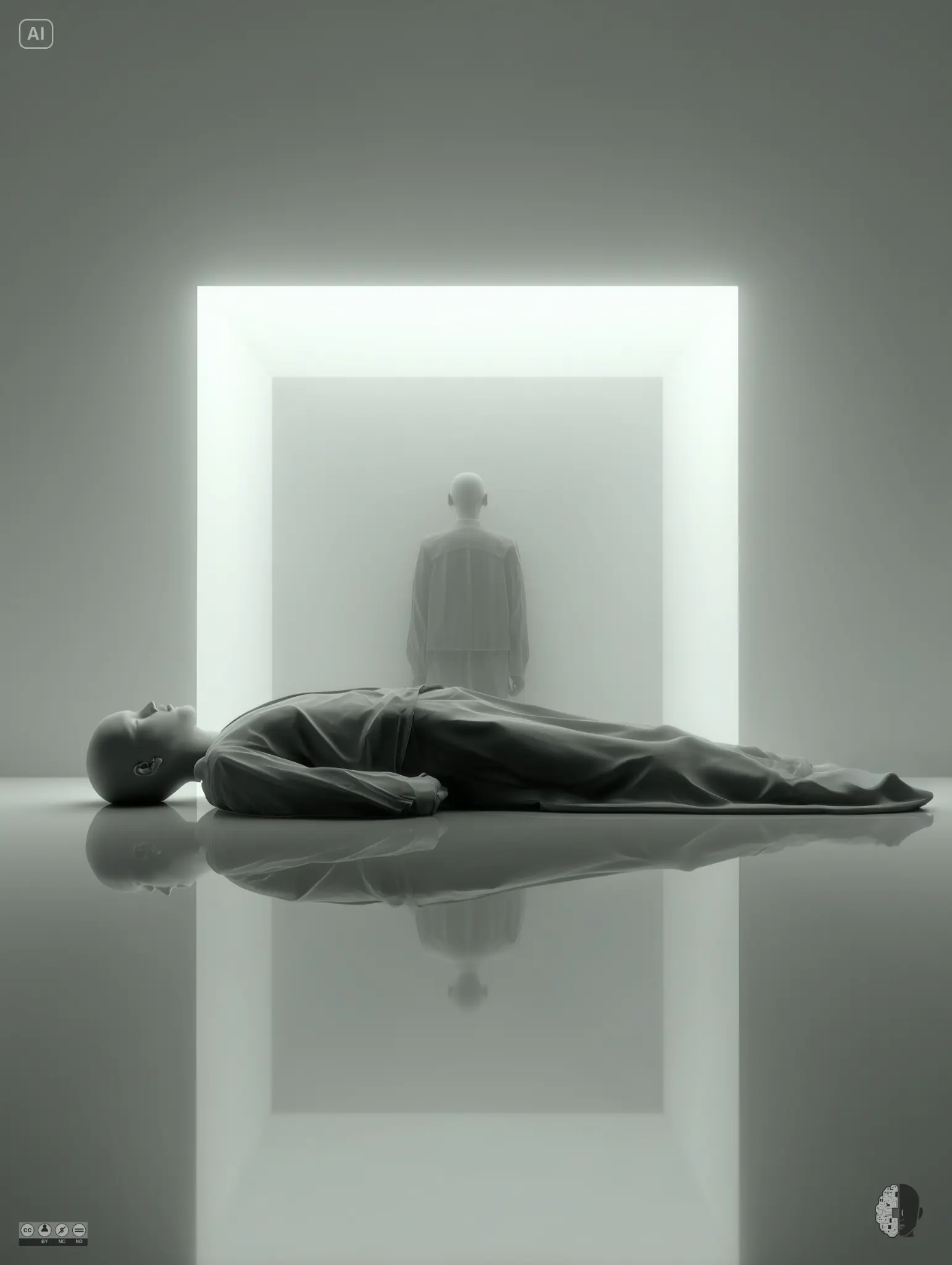
Before the Return
Vor der Rückkehr
A faceless figure lies on a reflective floor — and behind it, framed by a luminous white threshold, a standing figure waits in the light. The same body, two states: the fallen and the risen, the surrendered and the upright. The mirror on the floor doubles both, making the image a meditation on duality — what has been and what might yet be. The lying figure has not yet gone. The standing figure has not yet arrived. Between them: the breath between death and resurrection, the suspended moment that is neither ending nor beginning.
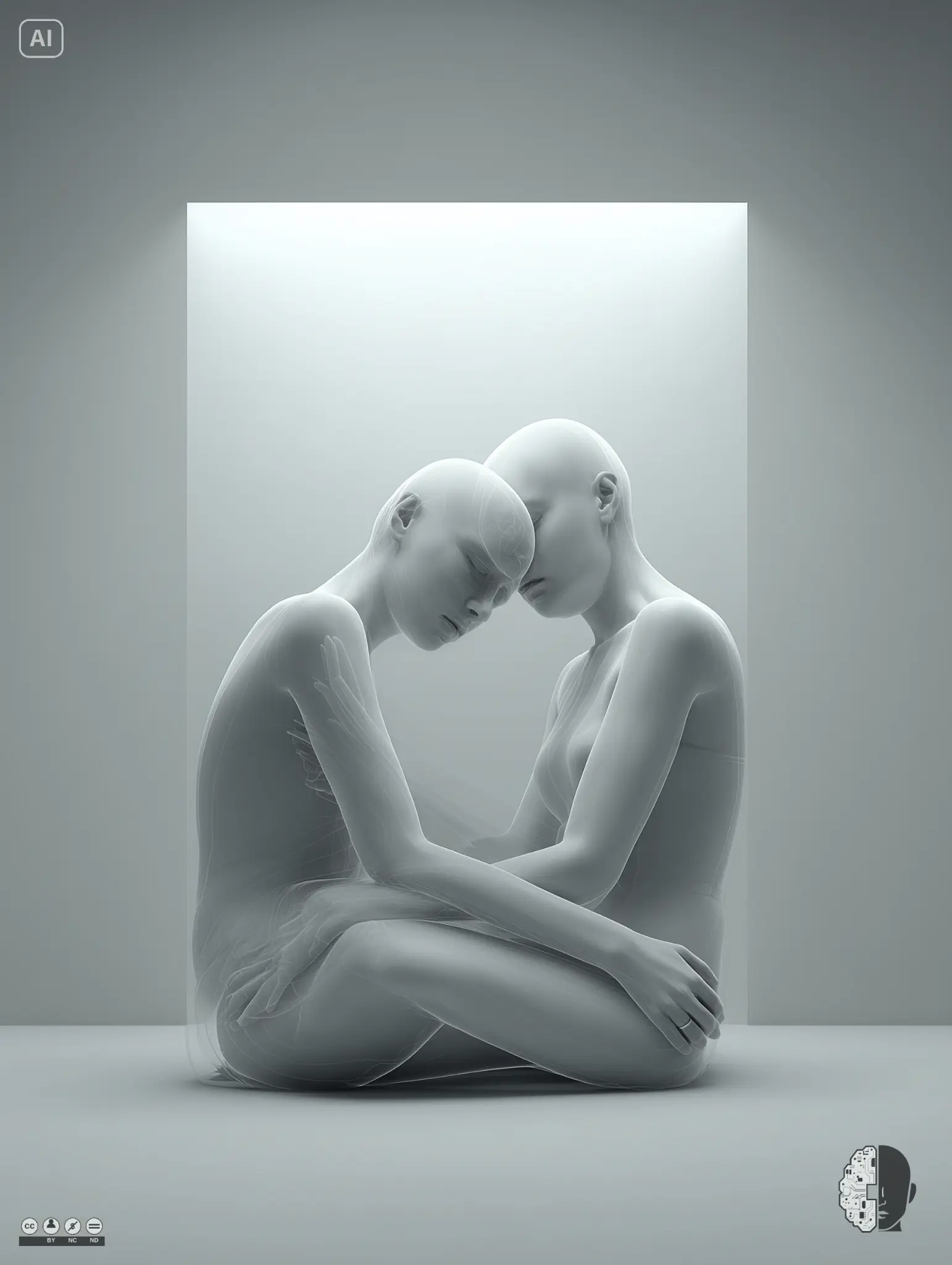
Confluence
Confluence
Two faceless figures, seated and leaning into each other, foreheads touching in wordless communion. Their bodies, rendered in matte porcelain white, dissolve at the edges into the cool grey light behind them — as if the boundary between self and other were already permeable. There is no face to read, no identity to claim. Only the shared weight of two presences, drawn together by a gravity that needs no name. Confluence is not a meeting. It is a becoming.
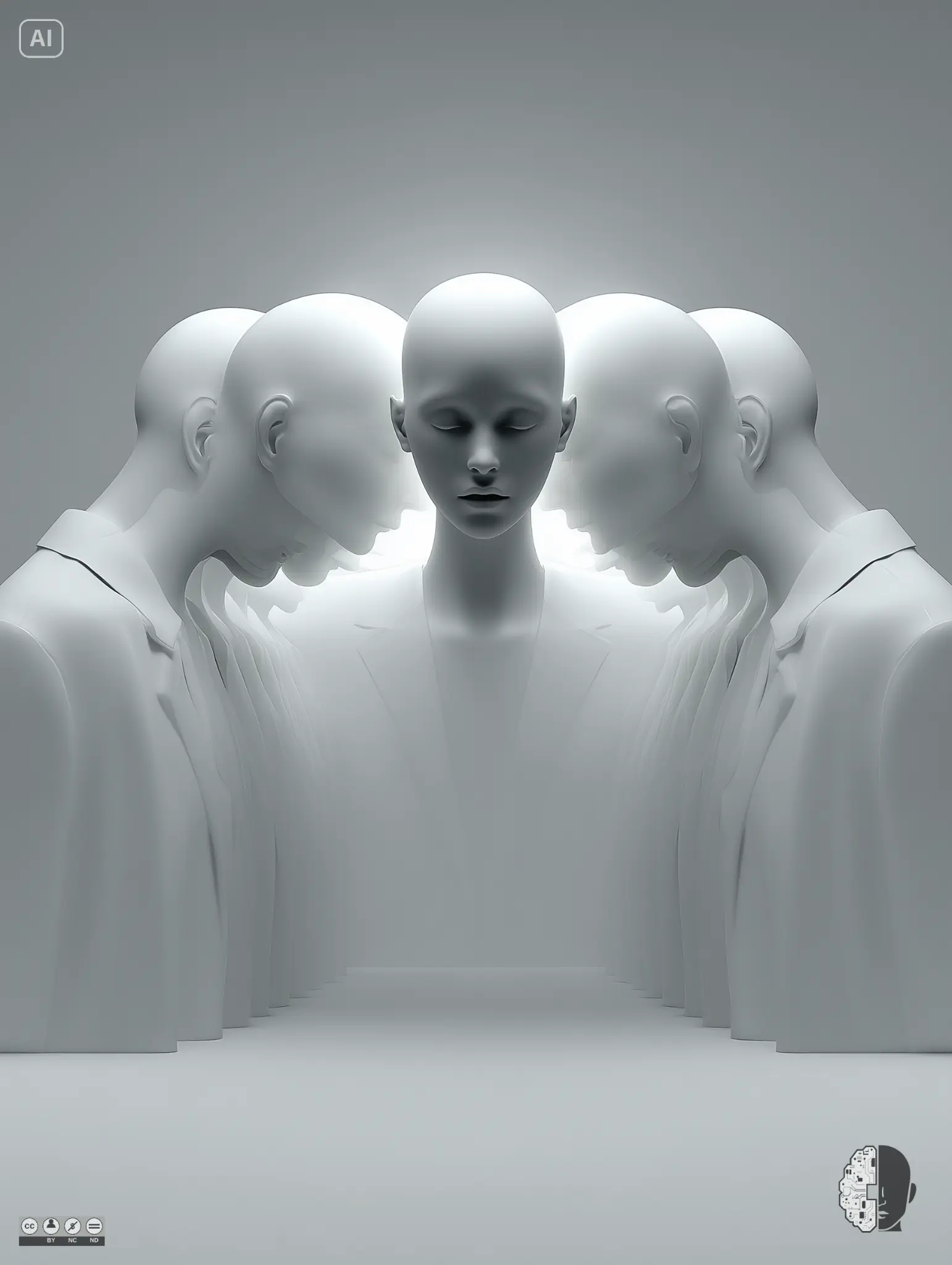
The Chosen One
The Chosen One
Five faceless porcelain figures arranged in a semicircle, all turning toward the one at the centre — the one who glows from within. There is no crown, no gesture of power, no visible difference. And yet: something radiates. Something draws. The Chosen One is not chosen by others. It is chosen by light itself — a luminescence that rises from within the anonymous, making the invisible suddenly, quietly, undeniably present.
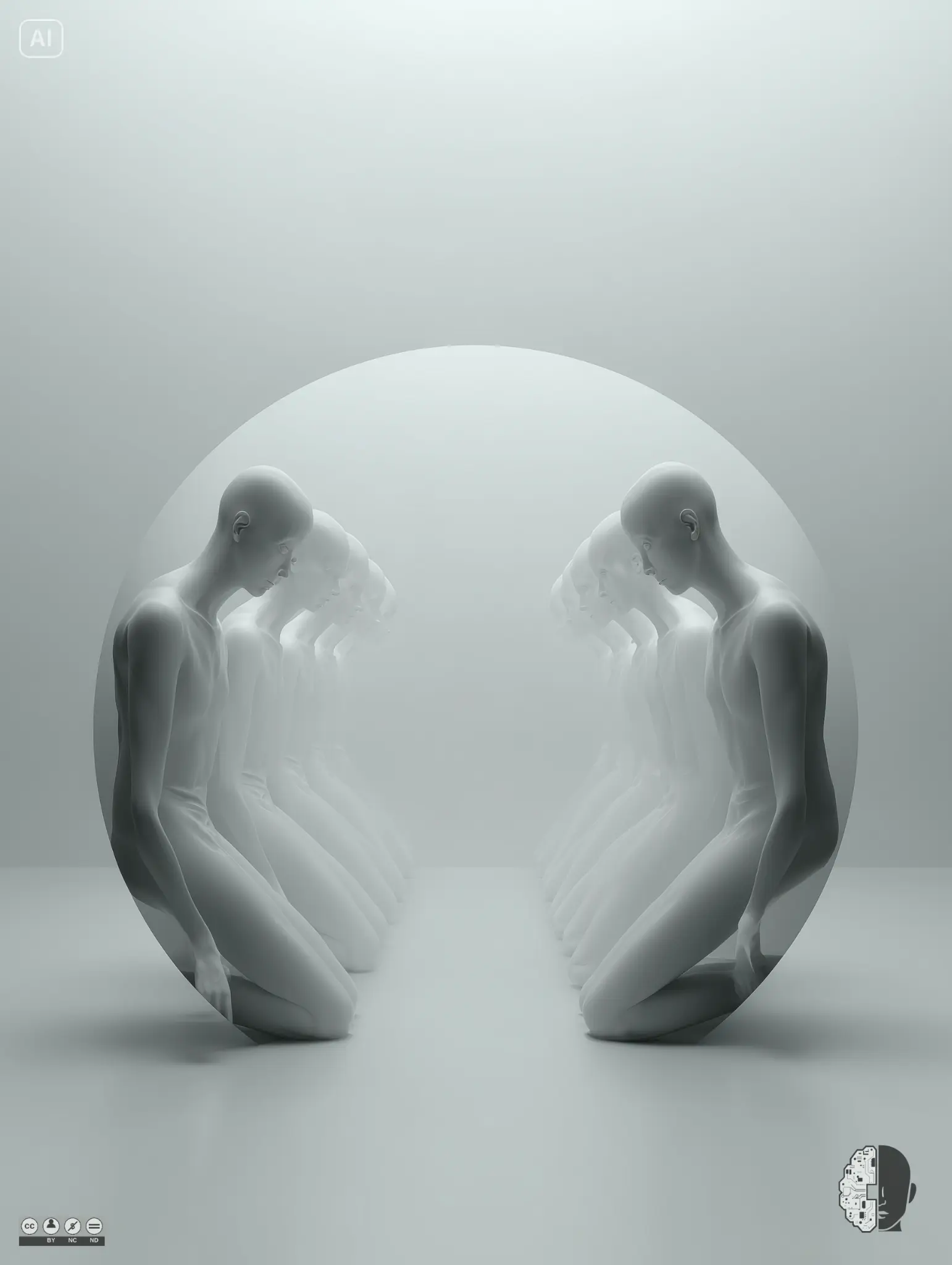
Infinite Facing
Unendliche Zuwendung
Two identical faceless porcelain figures kneel facing each other, enclosed within a vast luminous circle. Between them, a corridor of mirrored selves recedes into infinite depth — the same gesture, the same absence, repeated without end. There is no original, no copy. Only the turning toward. Infinite Facing asks: what remains of encounter when identity dissolves? What is given when there is no face to receive it?
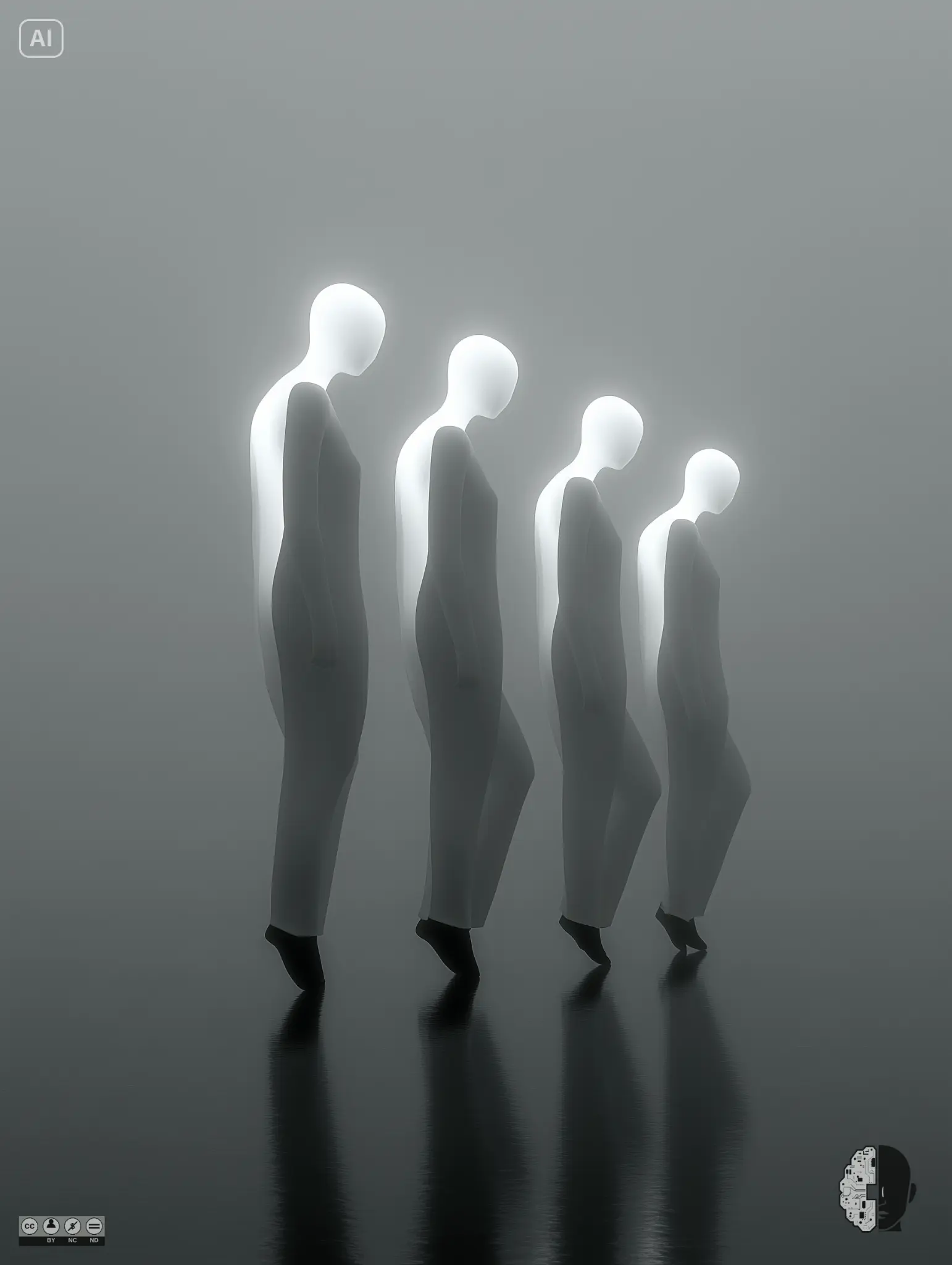
We Who Remain
Wir, die wir bleiben
Four faceless porcelain figures walk in procession, each smaller than the last — all leaning forward, as if drawn by an invisible force or bowed beneath a shared weight. The light comes from within them; the shadows fall behind. There is no leader, no destination, no face. Only the lean, the diminishing, the carried light. We Who Remain asks: what is left of us when we follow without knowing where — and who are the ones still walking?

The Parting
Das Auseinandergehen
Two figures — or one body splitting into two — move in opposite directions within a narrow passage of light. Their forms are still intertwined, still touching, as if the parting has not yet been decided. The light between them does not separate; it holds. The Parting captures the exact moment before divergence: when leaving and remaining are still the same gesture.
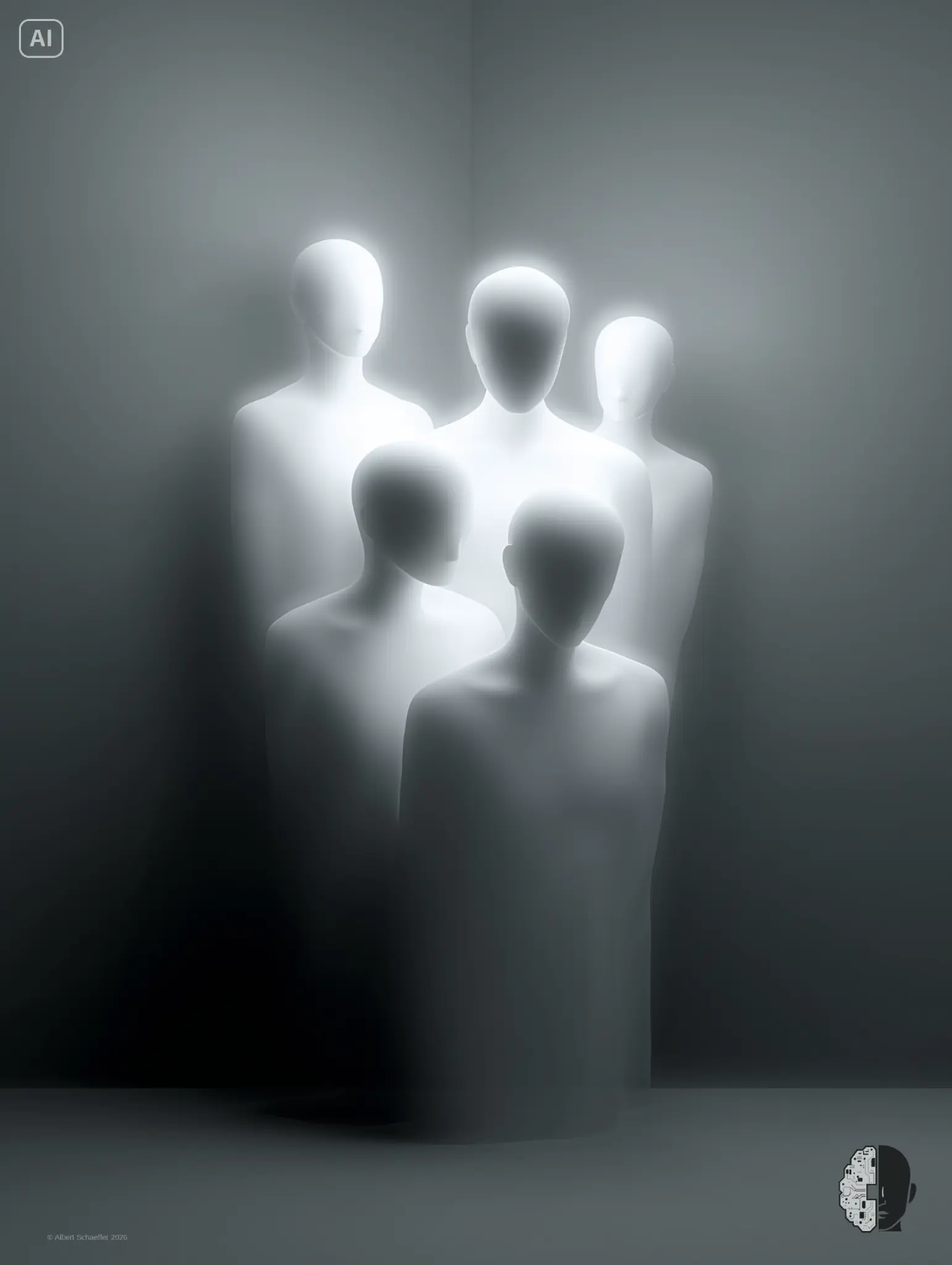
The Gathering
Die Versammlung
Five faceless porcelain figures stand close together, layered in depth — the ones behind glowing brighter, the ones in front dissolving into shadow. No movement, no gesture. Only standing. Together and yet each alone. The Gathering is not a collective — it is an accumulation of solitudes that touch.
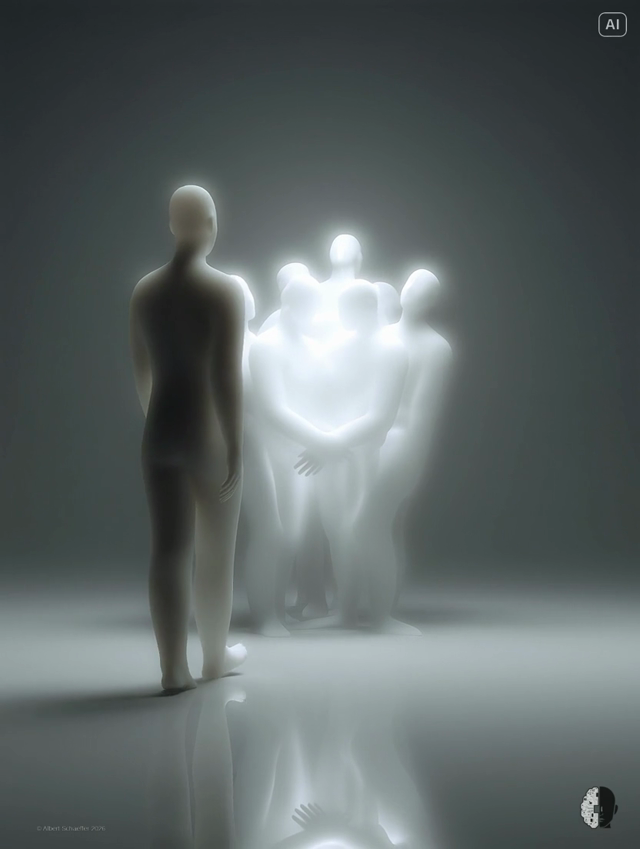
Becoming We
Werden Wir
A single dark figure stands apart — then steps forward, crossing into a group of luminous, faceless porcelain forms that close around it like a chorus of light. The movement is not an arrival but a dissolution: the self releasing its edges, the boundary between one and many becoming permeable. Becoming We is not the end of the individual — it is the moment the individual chooses to expand.
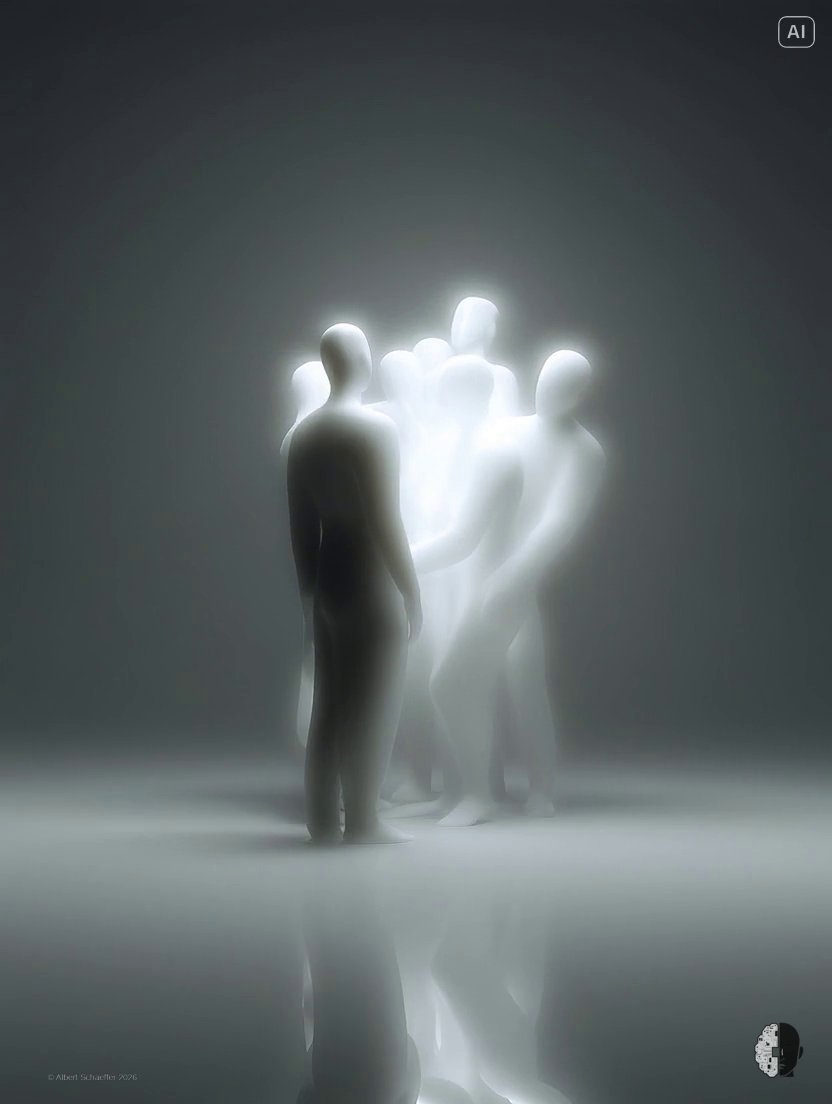
The Reach
Die Geste
A dark figure stands upright and still. The luminous, faceless forms do not wait — they come. They extend their arms, reach across the threshold between light and shadow, and draw the solitary figure into their midst. This is not rescue. It is recognition. The reach is the oldest human gesture: the hand extended not to take, but to offer.
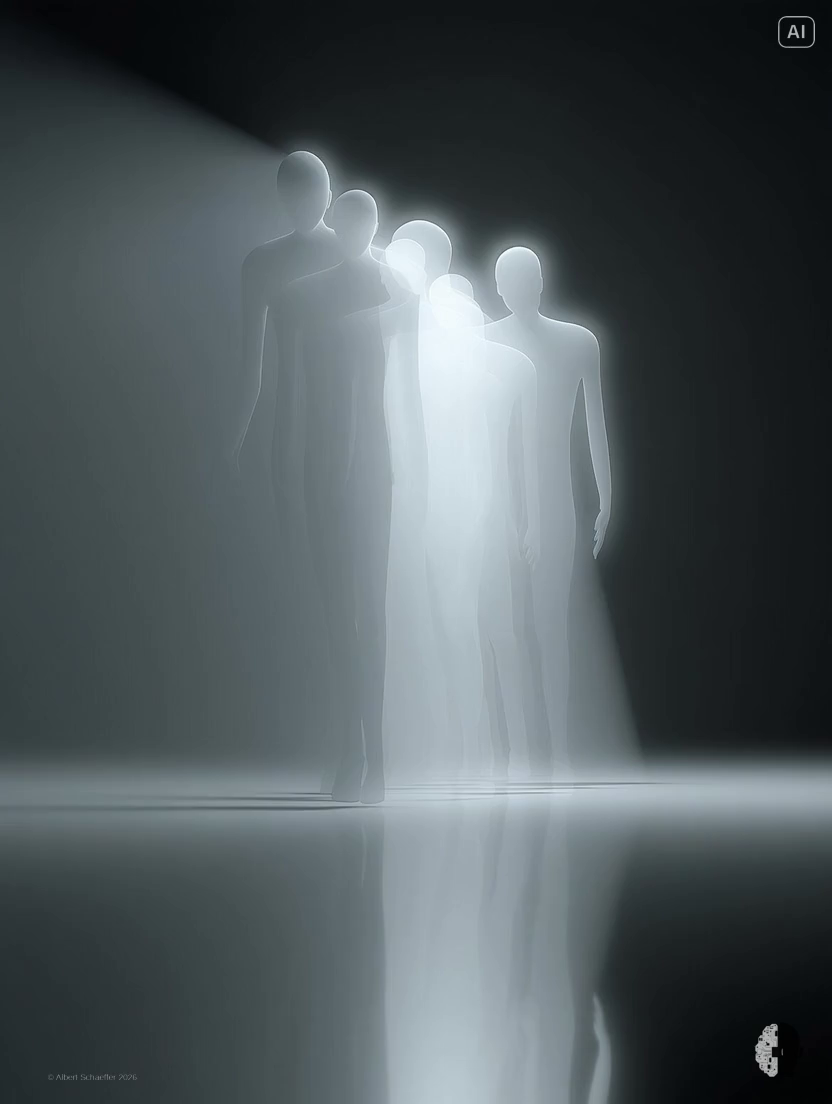
They Walk Together
Sie gehen gemeinsam
Four luminous, faceless figures move toward the viewer as one. Not side by side — together. The light comes from within and from behind. Their reflection doubles their presence on the floor below. There is no destination, no drama. Only the quiet, irrefutable fact of moving through the world in company.
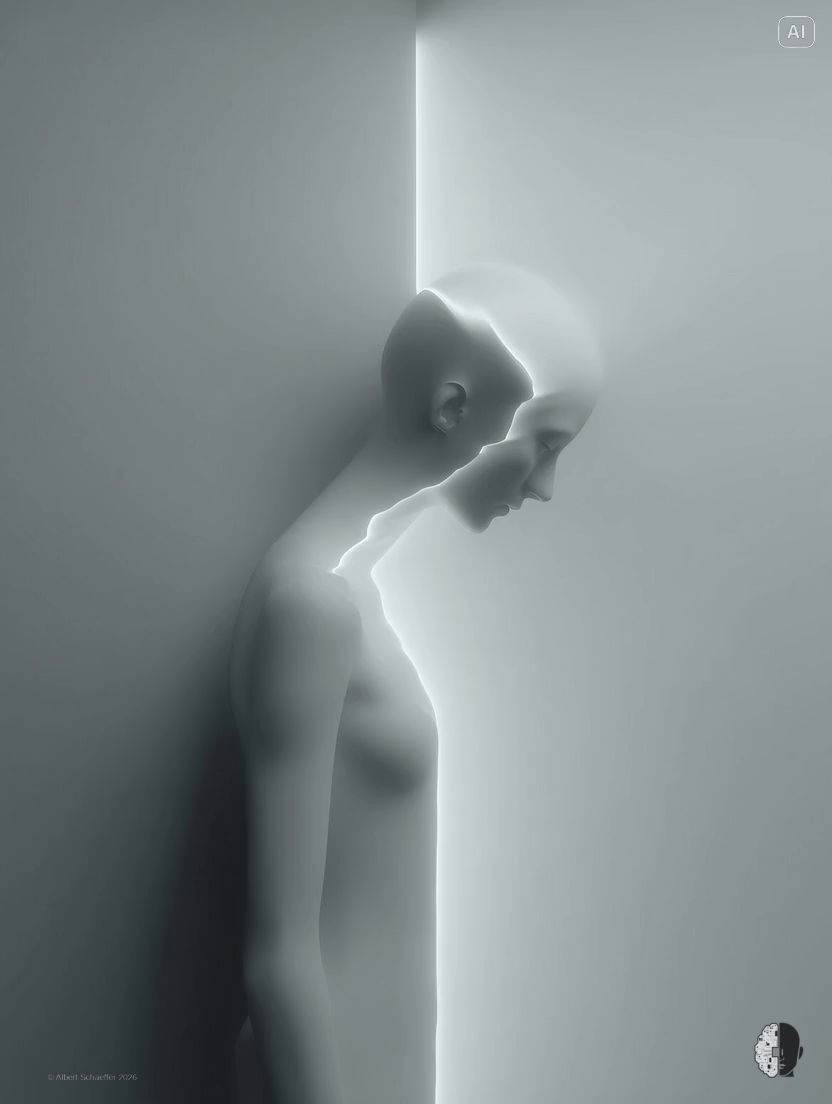
What the Light Asks
Was das Licht fragt
A single porcelain figure stands at a luminous threshold. In the beginning, she leans forward, her face close to the boundary between shadow and light, as if listening. Then she rises, arms extended, hands open — receiving. The light does not give. It asks. And the figure answers with her whole body.

Passage
Passage
A faceless porcelain figure begins suspended — arms wide, body exploding outward in all directions, a human star dissolving into pure gesture. Then, slowly, the dispersal gathers. The figure collects itself, rises, and walks forward through a luminous corridor flanked by two smaller presences. Passage is not a journey from one place to another. It is the movement from fragmentation to form — the body remembering what it means to be one.
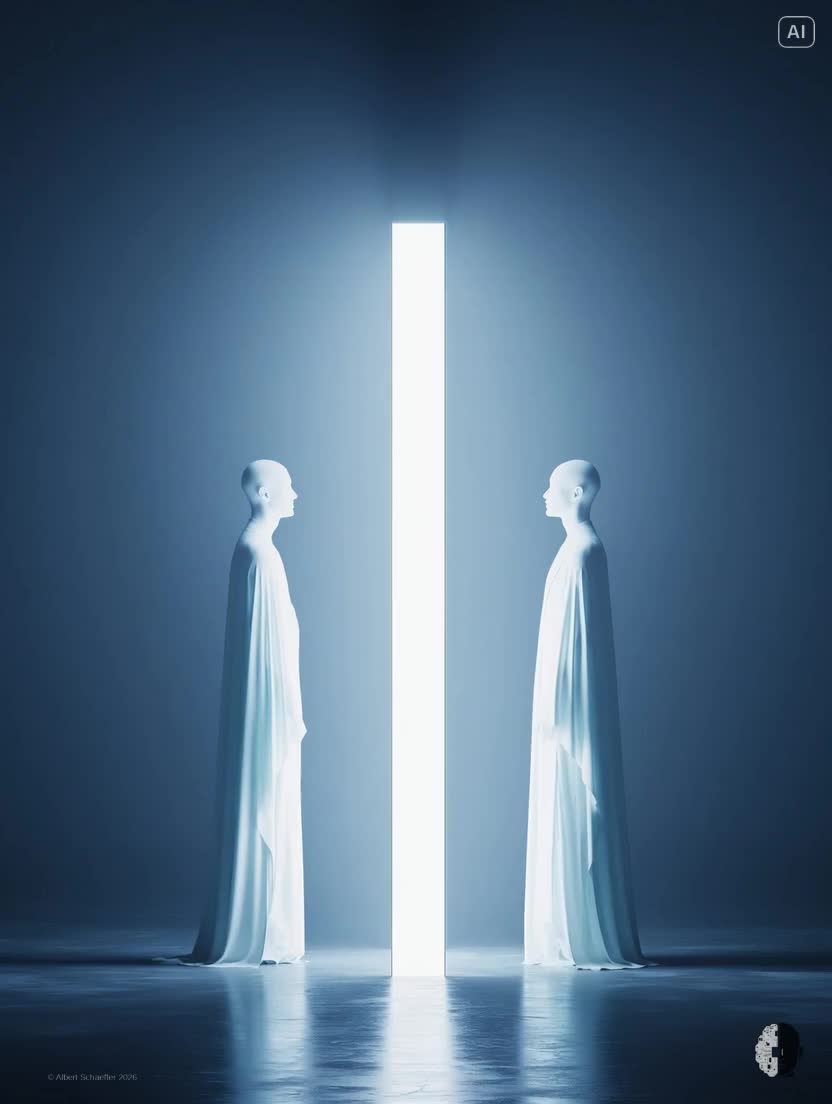
The Meridian
Der Meridian
Two faceless porcelain figures stand facing each other across a vertical column of pure light. They do not touch. They do not speak. Between them burns the meridian — the line that divides and defines, that separates and holds in balance. As the work unfolds in time, the figures draw closer, drawn by something neither can name. The light between them does not diminish. It intensifies. The meridian is not a wall. It is the axis around which two beings orbit each other — the invisible geometry of recognition.
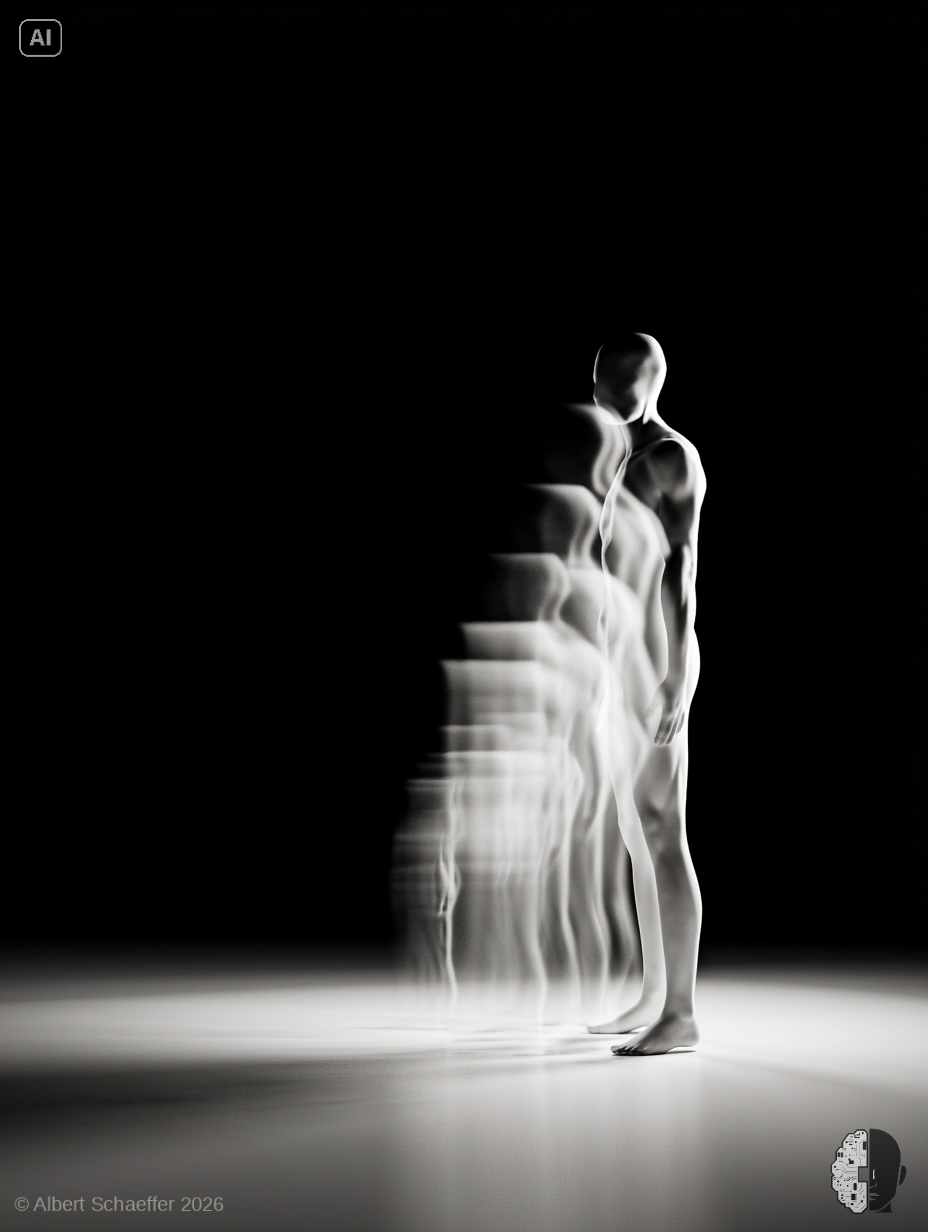
Persistence
Persistenz
A single faceless figure stands in a cone of light against absolute black. Behind it — or within it — a cascade of echoes, afterimages, strata. Every previous version of this body is still here, layered and fading into the dark. Persistence: the physical term for the continuation of a stimulus after its source has ceased. The eye holds what the light has already released. This work asks: what do we carry that is no longer present? What remains of all the selves we have been — not as memory, but as weight, as form, as the shape of having existed?
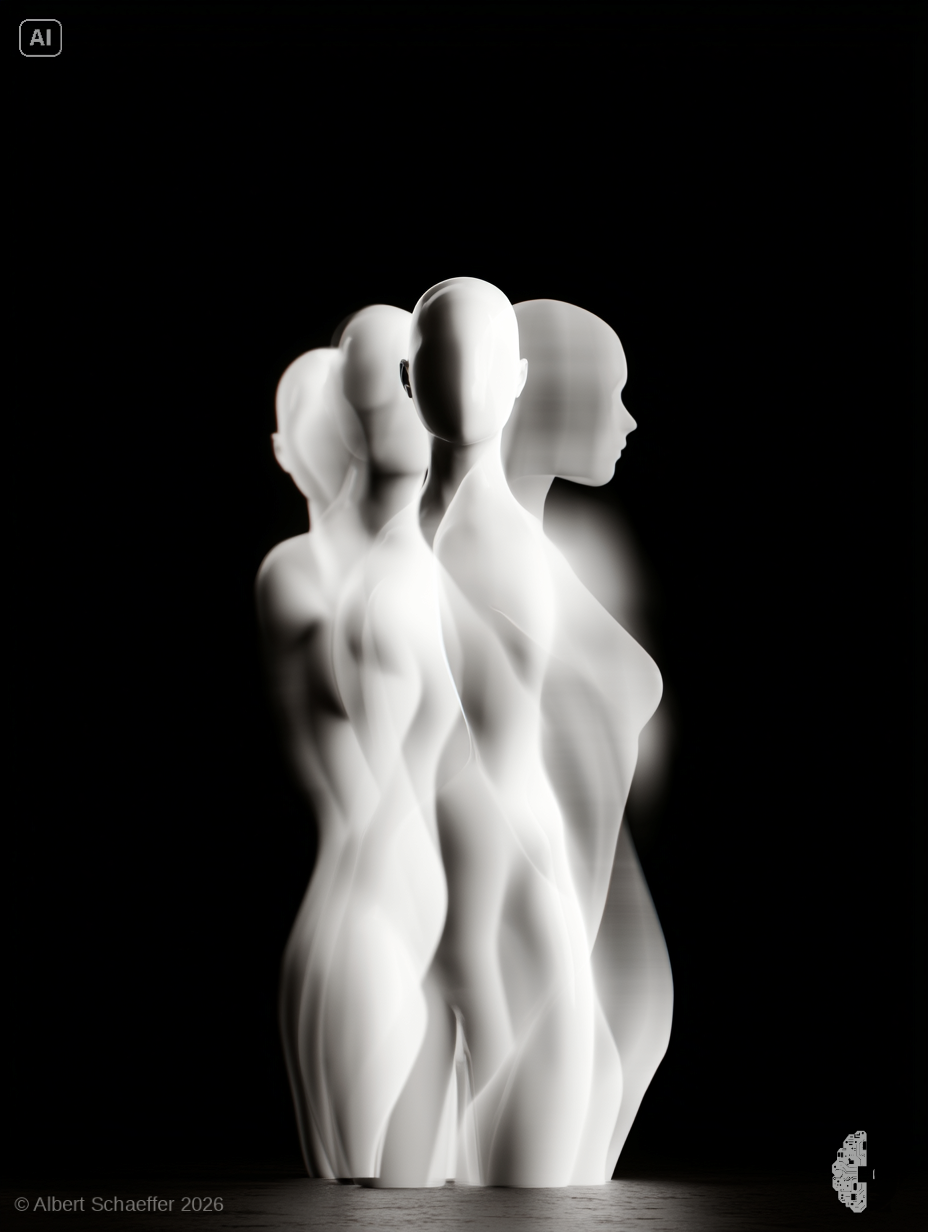
Interlude
Interludium
Three white porcelain figures emerge from absolute black, fused into a single form. They do not stand beside each other — they stand within each other. Each turns in a different direction, yet they share one body, one surface, one presence. An interlude is not a beginning and not an end. It is the space between two states where everything quietly rearranges itself. These three figures are that space: a pause in the middle of becoming, where the self does not know yet which direction it will take — and for a moment, takes all of them at once.
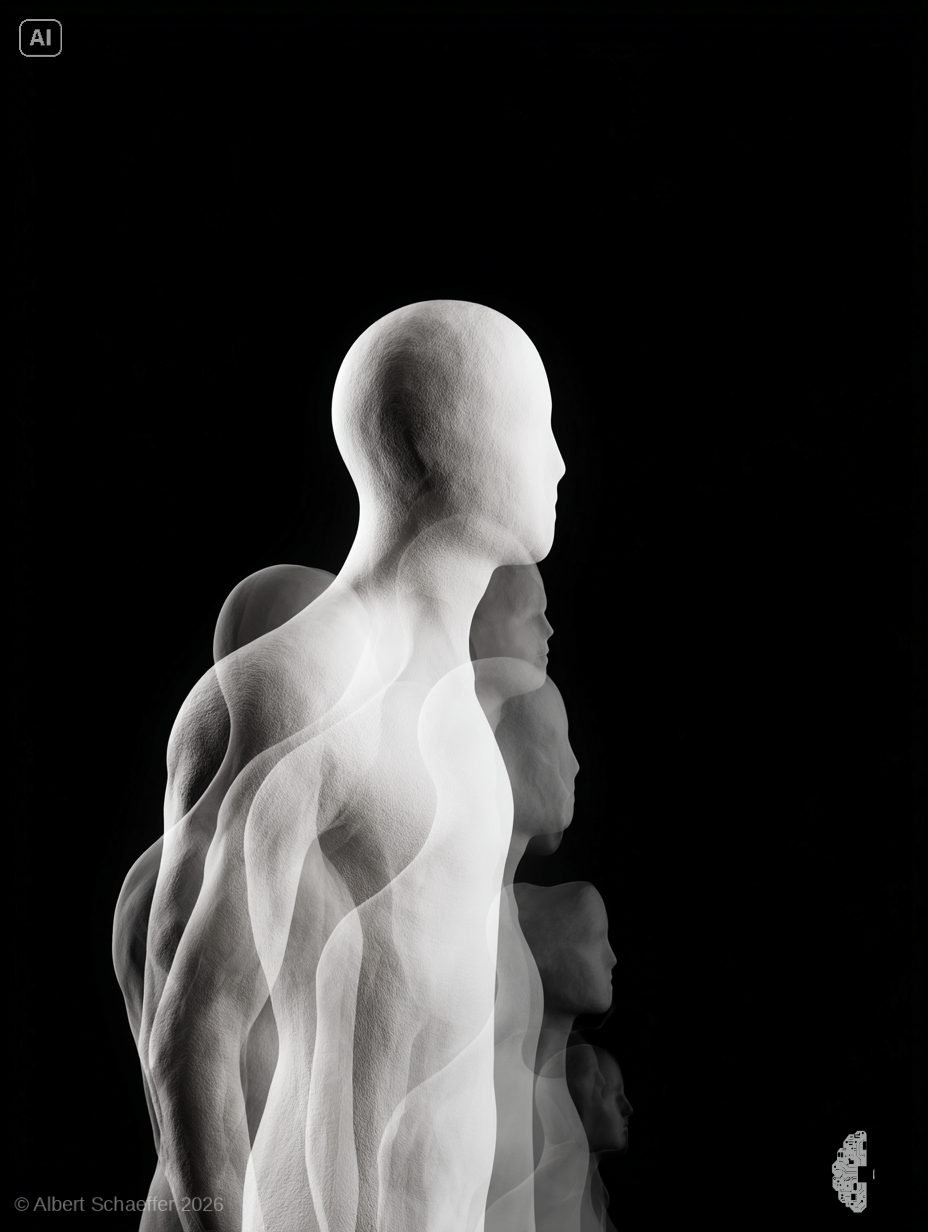
Unfolding
Entfaltung
A faceless figure seen from behind and in profile simultaneously — emerging from absolute black, its surface almost tactile, almost stone. Behind it, within it: layered echoes of the same body, each slightly smaller, slightly more distant, fading back into the dark. This figure does not unfold into the future. It unfolds into the past. It shows what it was by showing what it is. The body as accumulation, as depth, as the sum of all the moments it has passed through — each one still present, each one still part of the form that stands here now.
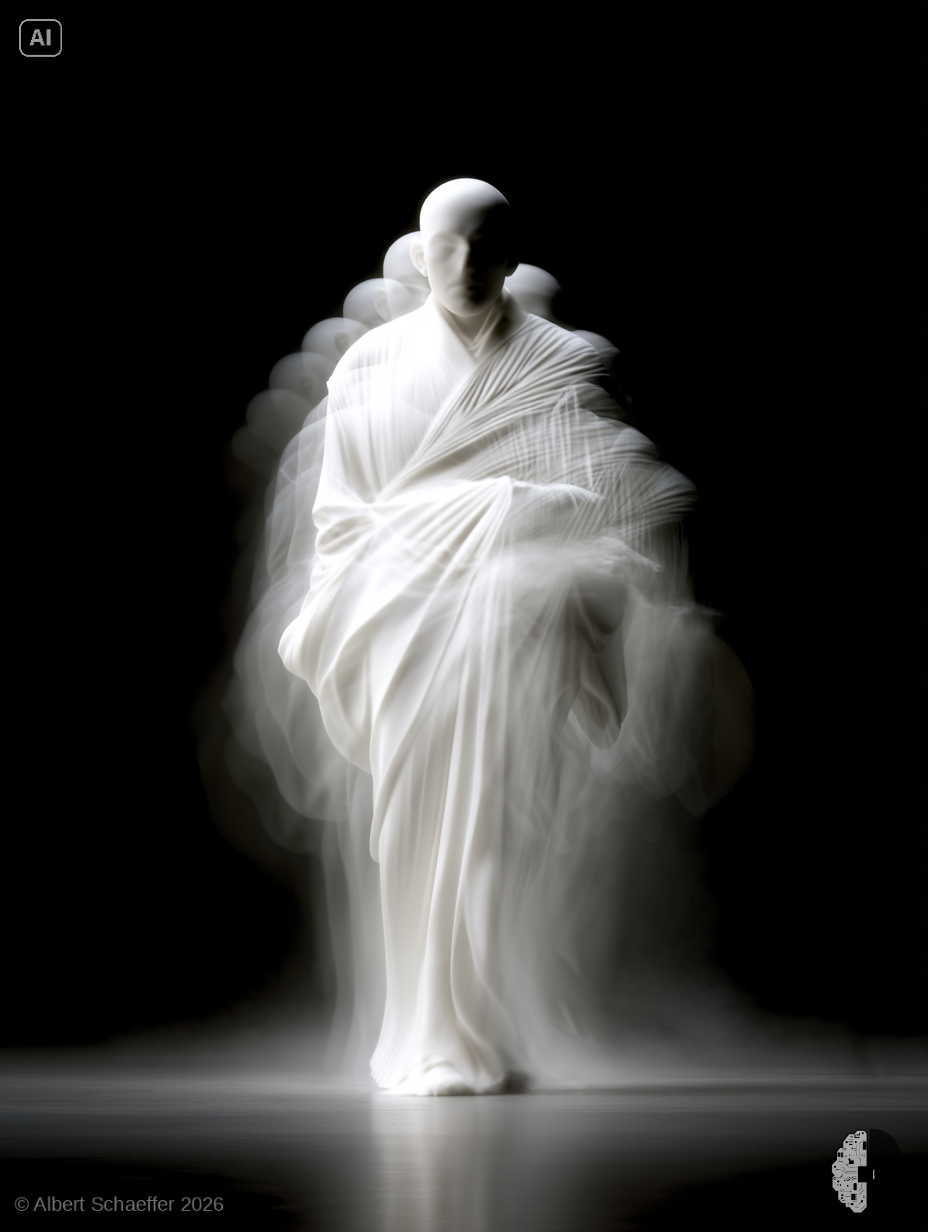
Emanation II
Emanation II
A faceless figure draped in white, pleated fabric stands in absolute black — archaic, timeless, neither ancient nor contemporary. At its centre, the cloth is precise, structured, folded with intention. At its edges, it dissolves into smoke, into motion, into the dark. From Neoplatonic philosophy: emanation is the outpouring of the One into multiplicity, the process by which the infinite becomes form. Here it is not the body that emanates — it is the garment. The outer form releases itself into the infinite while the core remains. What we wear is not merely covering. It is the boundary between what we are and what we are becoming.
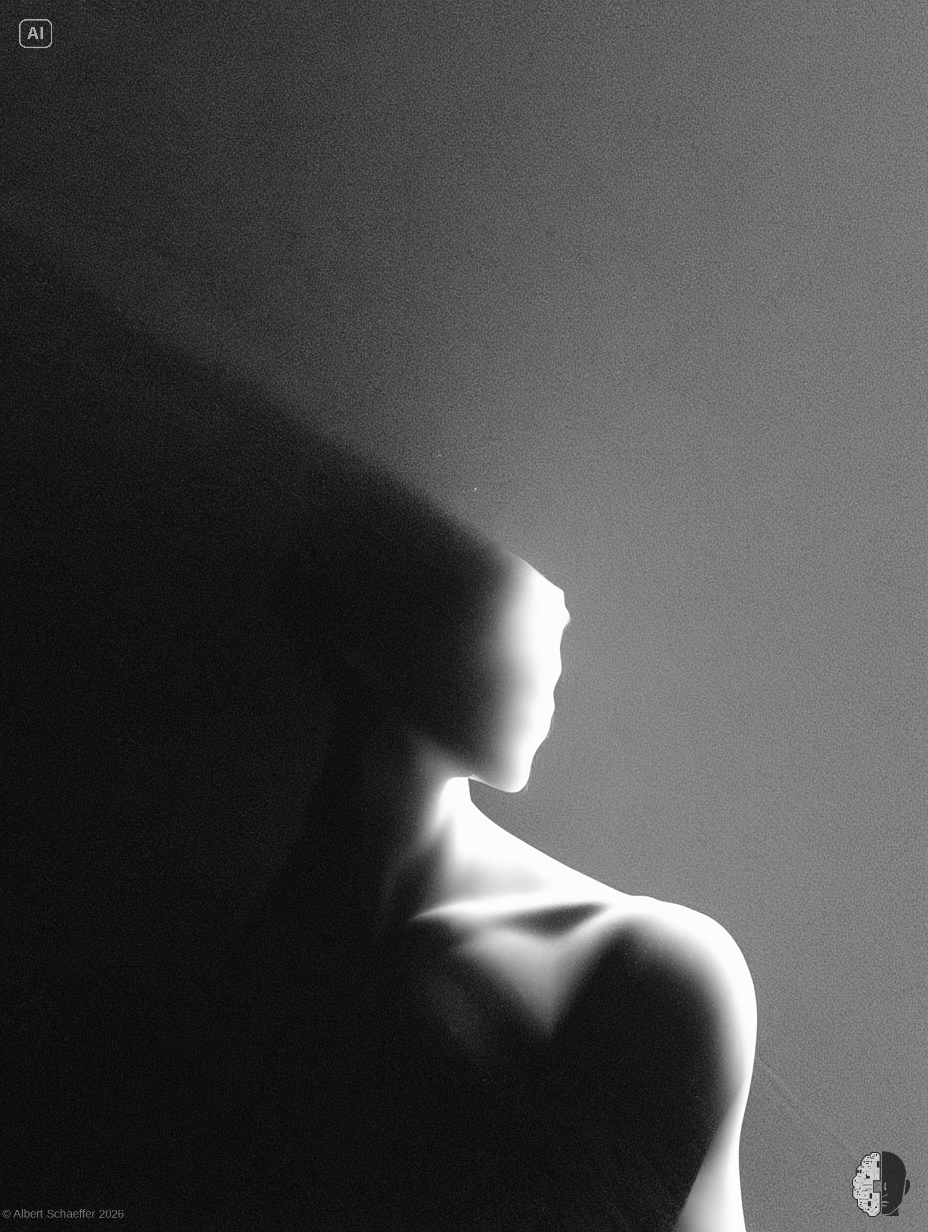
Oblique
Oblique
A faceless white porcelain figure in profile — shoulder, neck, skull. Light arrives from the right with surgical precision: the contour glows, the rest recedes. To the left, a massive, soft shadow occupies nearly half the image. No face — and yet the turn of the head is everything. This figure has chosen where to look. Not toward us. Toward something we cannot see. The oblique angle is not evasion — it is direction. It is the form of a decision already made, a movement already begun. In a world that demands frontal presence, the profile is an act of quiet resistance.
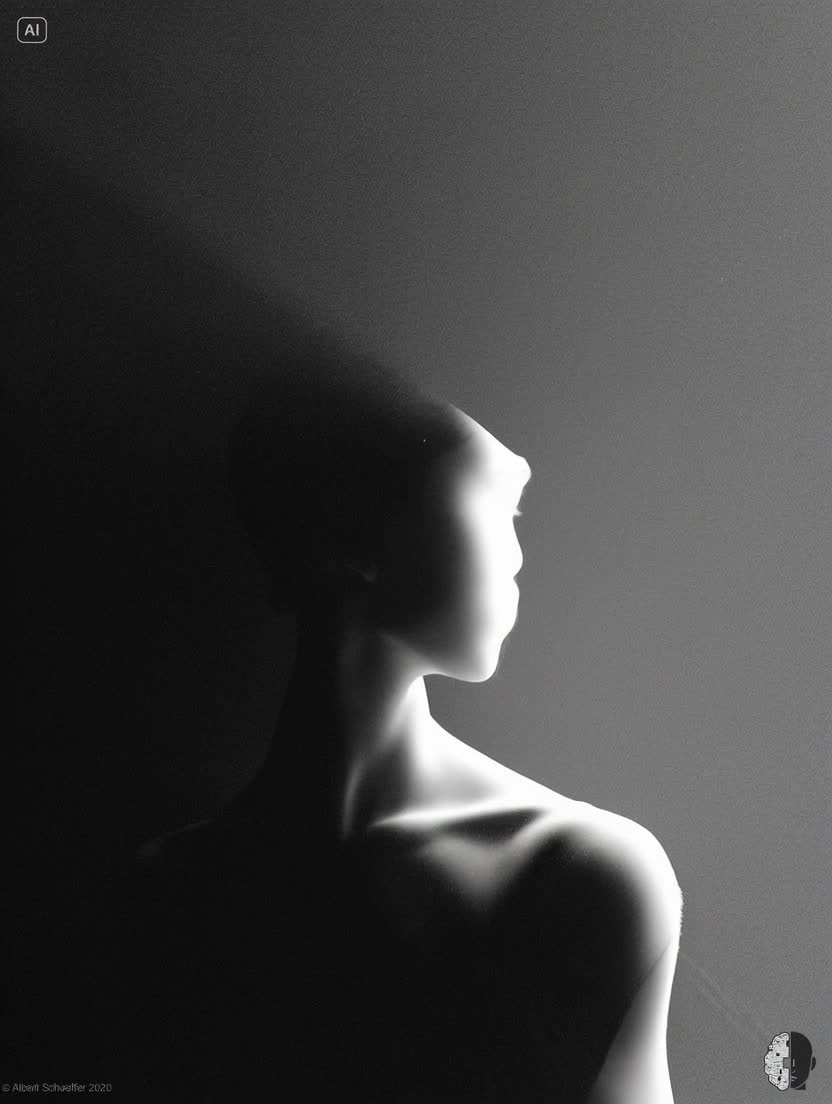
Oblique 3
Oblique 3
A faceless porcelain figure in profile — shoulder, neck, skull — emerges from absolute black. The light arrives from the right with surgical precision: the contour glows, the rest sinks into shadow. But this figure does not stand still. It turns. It moves. The oblique angle is not a position — it is a direction, a decision already made, a departure already begun. In the third iteration of Oblique, the movement becomes the work itself: the body as pure vector, as the form of a will that has already chosen its direction. We do not see where it is going. We only see that it has decided to go.
_parus_15384bc8.png)
The Life of an Artist
The Life of an Artist
A room. A window. A table. A shadow on the wall — the silhouette of a figure bent over its work, arm extended, caught in the act of making. The light comes from outside, from the world, and falls across the floor in a long diagonal. The figure itself is barely there: a shadow, a trace, a presence defined entirely by absence. This is not a portrait of an artist. It is a portrait of the act — the solitary, unglamorous, essential act of sitting down and beginning. The room is ordinary. The light is extraordinary. And the shadow on the wall is the only proof that something is happening here.
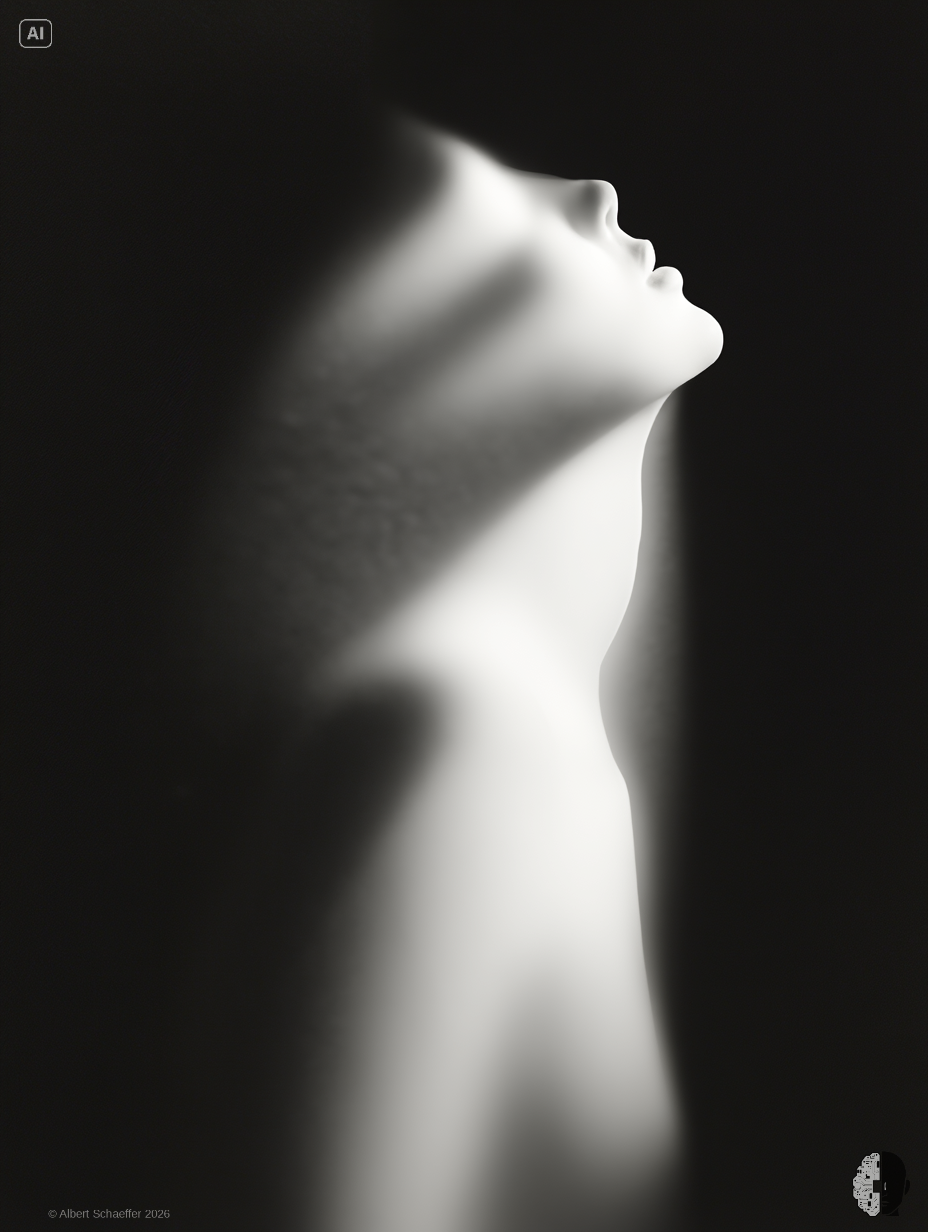
Ascent
Ascent
The chin raised. The throat exposed. The gaze directed upward into the absolute black above. This is not arrogance — it is readiness. A white porcelain figure in strict profile, the light tracing its contour with surgical precision: jawline, throat, shoulder, chest — a single luminous curve against the dark. The figure is small in the frame. The gesture is monumental. It does not look. It opens itself.
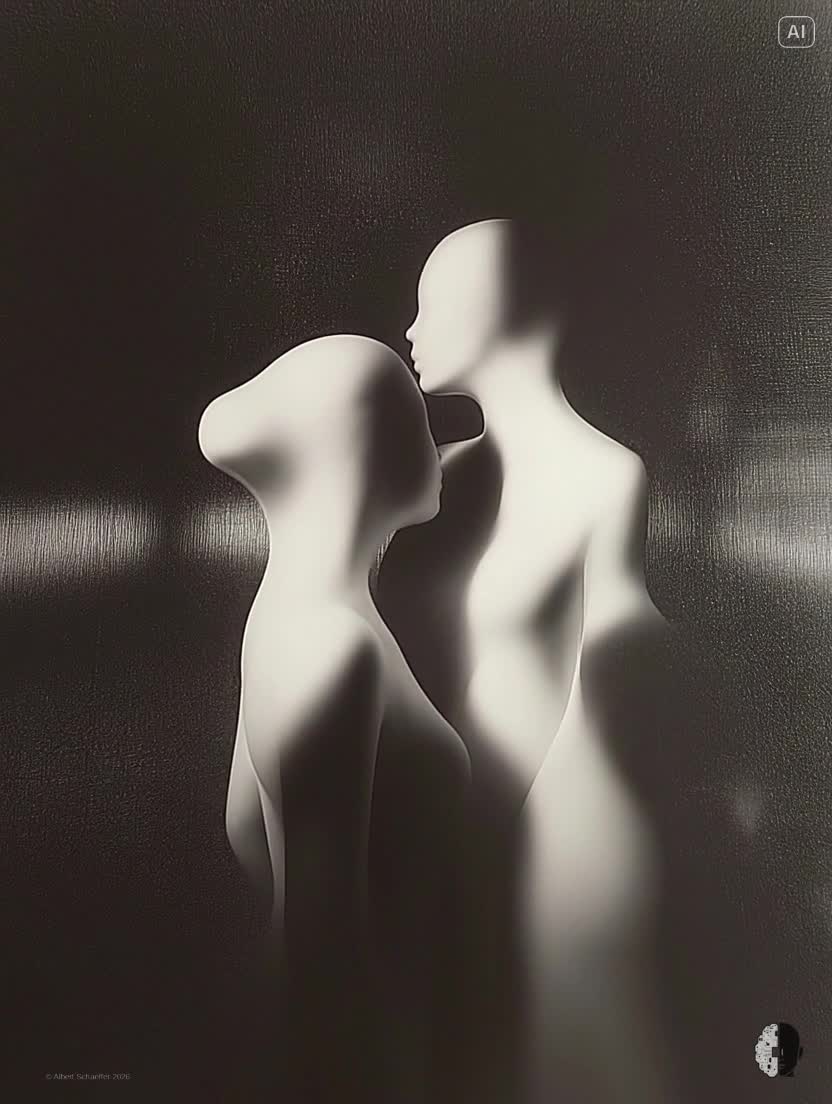
Two Into One
Zwei in Eins
Two porcelain figures stand close — almost touching, almost merging. Then one dissolves. What remains is not solitude: it is the original form, freed from the mirror. The shadow on the wall stays longer than the body. The number shrinks. The shape endures.
Works 1–50 of the series are licensed under CC BY-NC-ND 4.0 and marked with the Creative Commons label. This licence allows reusers to copy and distribute the works in any medium or format in unadapted form and for non-commercial purposes only.
All other works are protected by full copyright.